It is apparent from the above discussion that the prediction of the rates at which heat is convected away from the solid surface by an ambient fluid involves thorough understanding of the principles of heat conduction, fluid dynamics, and boundary layer theory. All the complexities involved in such an analytical approach may be lumped together in terms of a single parameter by introduction of Newton’s law of cooling,

where, h is known as the heat transfer coefficient or film coefficient. It is a complex function of the fluid composition and properties, the geometry of the solid surface, and the hydrodynamics of the fluid motion.
If k is the thermal conductivity of the fluid, the rate of heat transfer can be written directly by following the Fourier’s law. Therefore, we have,

where, is the temperature gradient in the thin film where the temperature gradient is linear.
On comparing eq.3.1 and 3.2, we have,

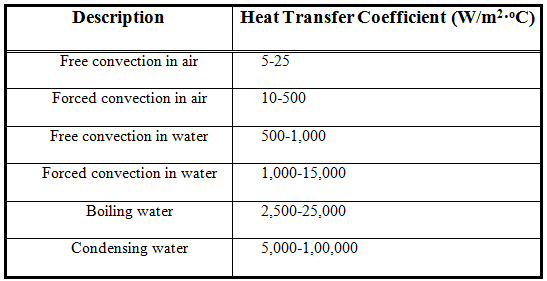
It is clear from the above expression that the heat transfer coefficient can be calculated if k and δ are known. Though the k values are easily available but the δ is not easy to determine. Therefore, the above equation looks simple but not really easy for the calculation of real problems due to non-linearity of k and difficulty in determining δ. The heat transfer coefficient is important to visualize the convection heat transfer phenomenon as discussed before. In fact, δ is the thickness of a heat transfer resistance as that really exists in the fluid under the given hydrodynamic conditions. Thus, we have to assume a film of δ thickness on the surface and the heat transfer coefficient is determined by the properties of the fluid film such as density, viscosity, specific heat, thermal conductivity etc. The effects of all these parameters are lumped or clubbed together to define the film thickness. Henceforth, the heat transfer coefficient (h) can be found out with a large number of correlations developed over the time by the researchers. These correlations will be discussed in due course of time as we will proceed through the modules. Table 3.1 shows the typical values of the convective heat transfer coefficient under different situations.
Table-3.1: Typical values of h under different situations