The rate of heat transfer in a solid body or medium can be calculated by Fourier’s law. Moreover, the Fourier law is applicable to the stagnant fluid also. However, there are hardly a few physical situations in which the heat transfer in the fluid occurs and the fluid remains stagnant. The heat transfer in a fluid causes convection (transport of fluid elements) and thus the heat transfer in a fluid mainly occurs by convection.
3.1 Principle of heat flow in fluids and concept of heat transfer coefficient
It is learnt by day-to-day experience that a hot plate of metal will cool faster when it is placed in front of a fan than exposed to air, which is stagnant. In the process, the heat is convected away, and we call the process convective heat transfer. The term convective refers to transport of heat (or mass) in a fluid medium due to the motion of the fluid. Convective heat transfer, thus, associated with the motion of the fluid. The term convection provides an intuitive concept of the heat transfer process. However, this intuitive concept must be elaborated to enable one to arrive at anything like an adequate analytical treatment of the problem.
It is well known that the velocity at which the air blows over the hot plate influences the heat transfer rate. A lot of questions come into the way to understand the process thoroughly. Like, does the air velocity influence the cooling in a linear way, i.e., if the velocity is doubled, will the heat transfer rate double. We should also suspect that the heat-transfer rate might be different if we cool the plate with some other fluid (say water) instead of air, but again how much difference would there be? These questiones may be answered with the help of some basic analysis in the later part of this module.
The physical mechanism of convective heat transfer for the problem is shown in fig.3.1.
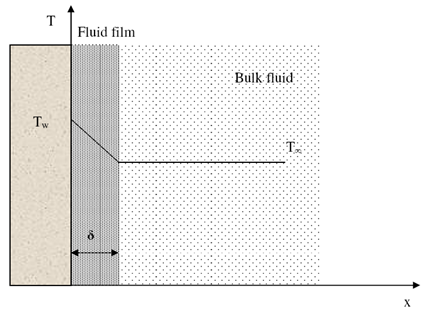
Fig. 3.1: Convective heat transfer from a heated wall to a fluid
Consider a heated wall shown in fig.3.1. The temperature of the wall and bulk fluid is denoted by  respectively. The velocity of the fluid layer at the wall will be zero. Thus the heat will be transferred through the stagnant film of the fluid by conduction only. Thus we can compute the heat transfer using Fourier’s law if the thermal conductivity of the fluid and the fluid temperature gradient at the wall is known. Why, then, if the heat flows by conduction in this layer, do we speak of convective heat transfer and need to consider the velocity of the fluid? The answer is that the temperature gradient is dependent on the rate at which the fluid carries the heat away; a high velocity produces a large temperature gradient, and so on. However, it must be remembered that the physical mechanism of heat transfer at the wall is a conduction process.