- • Alkylation reactor: The reactor is arranged as a series of CSTRs with acid fed in the first CSTR and feed supplied to different CSTRs. This arrangement is for maximizing the conversion.
• In the alkylation reactor it is important to note that the olefin is the limiting reactant and isoparaffin is the excess reactant.
• The alkylator unit therefore will have two phases in due course of reaction namely the olefin + isoparaffin mixture which will be lighter and the alkylate stream which will be heavier and will be appearing as a bottom fraction if allowed to settle.
• Since excess isoparaffin is used, the isoparaffin can be easily allowed as a bypass stream.
• Eventually, the alkylate product from the last reactor will be taken out as a heavy stream.
• Thus, the alkylation reactor produces two streams. These are (a) isoparaffin rich organic phase and (b) alkylate rich phase along with acid and isobutane phases.
• These streams should be subjected to further purification.
• Phase separator: It so happens that the acid enters the organic rich stream and will be subjected to phase separation by settling. Similarly, the olefin/isoparaffin mixture will be also separated by gravity settling. Thus the phase separator produces three streams namely (a) olefin + isoparaffin rich phase (b) acid rich stream (c) alkylate rich stream.
• Olefin + Paraffin processing: The olefin + paraffin stream is first subjected to compression followed by cooling. When this stream is subjected to throttling and phase separation, then the olefin + paraffin rich stream will be generated. The propane rich stream from this stream is generated as another stream in the phase separator.
• Propane defractionator: The propane rich stream after cooling is fed to a fractionator where propane is separated from the olefin+isoparaffin mixture. The olefin+isoparaffin mixture is sent back to mix with the olefin feed.
• Caustic wash for alkylate rich stream: The caustic wash operation ensures to completely eliminate acid concentration from the alkylate.
• Alkylate fractionation: The alkylate is fed to a distillation column that is supplied with isobutane feed and alkylate feeds to produce isobutane as a top product and alkylate + butane mixture as a bottom product.
• Debutanizer: The debutanizer separates butane and alkylate using the concept of distillation.
9.5 HF process technology (Figure 9.2)
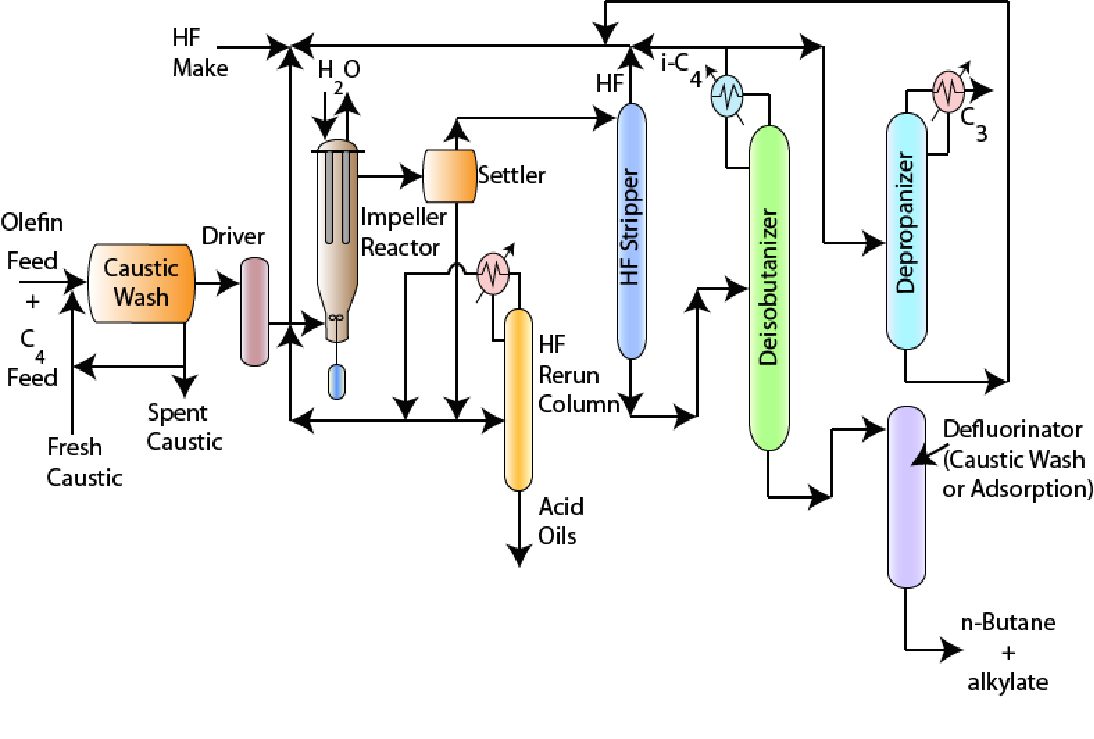 |
Figure 9.2 HF Alkylation Processes
- • The process is similar to the sulphuric acid plant. However, additional safety issues make the process complex.
• The feed is first subjected to drying followed by pre-cooling.
• After pre-cooling the reaction mixture the reaction mixture is fed to a reactor.
• Unlike CSTRs in series here impeller reactors are used. The reactor consists of cooling tubes to absorb the heat generated.
• The reaction products enters a settler where oil and the HF are separated.
• Since there can be traces of HF in the oil rich phase and vice-versa additional processing is followed.
• The HF rerun column removes traces of oils from the bulk of the HF. Thus HF purified will be recycled back to the reactor. The bottom product thus generated in this unit is acid oils.
• A HF stripper is used to remove the HF in lower quantities from the alkylate product. Eventually, the HF stripper produces HF that is sent back to the reactor and the alkylate product.
• The alkylate product is sent to a deisobutanizer and depropanizer units. The final alkylate product is produced by using a deflourinator which is basically a caustic wash or adsorption unit. Finally n-butane + alkylate is produced as the bottom product.