8.4 Hydrocracking
8.4.1 Process summary
- • Cycle oils and coker distillates are the typical feedstocks.
-
• High quality jet fuel and diesel production is targeted.
- •
- verall reaction is exothermic.
-
• Cracking is promoted on silica-alumina sites of the catalyst. Hydrogenation promoted by palladium, molybdenum sulphide or tungsten sulphide compounds.
-
• Since catalyst gets poisoned with organic nitrogen compounds, hydrotreater catalytic reactors are used before hydrocracking reactors to safeguard the hydrocracking catalysts.
- • Excess hydrogen also aids in preventing catalyst coking.
-
• Operating conditions of the hydrocracking reactor: 340 – 425°C and 70 – 200 bar.
8.4.2 Process Technology (Figure 8.3)
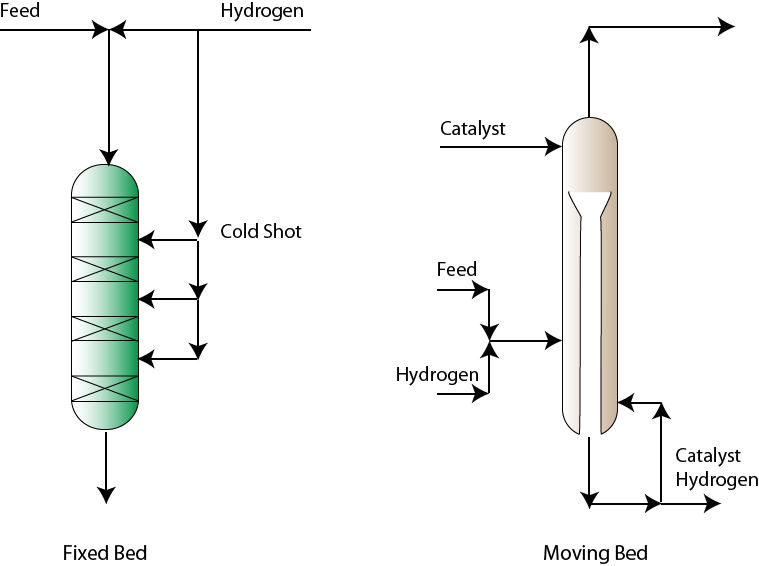
Figure 8.2 Fixed Bed and Moving Bed
.
- • Reactors use fixed or moving bed reactors in which fixed beds are more common.
- • The three phase separator generates three streams namely sour water stream, organic stream and a gas stream.
• Packed beds: Cold shot reactors are used in which cold H2 is used to cool the hot streams. Guard reactors are used before hydrocracking catalyst within the reactor column itself
• Moving beds: Feed allows movement of the catalyst for good mixing.
• After reaction, the product gets mixed with water and enters a three phase separator.
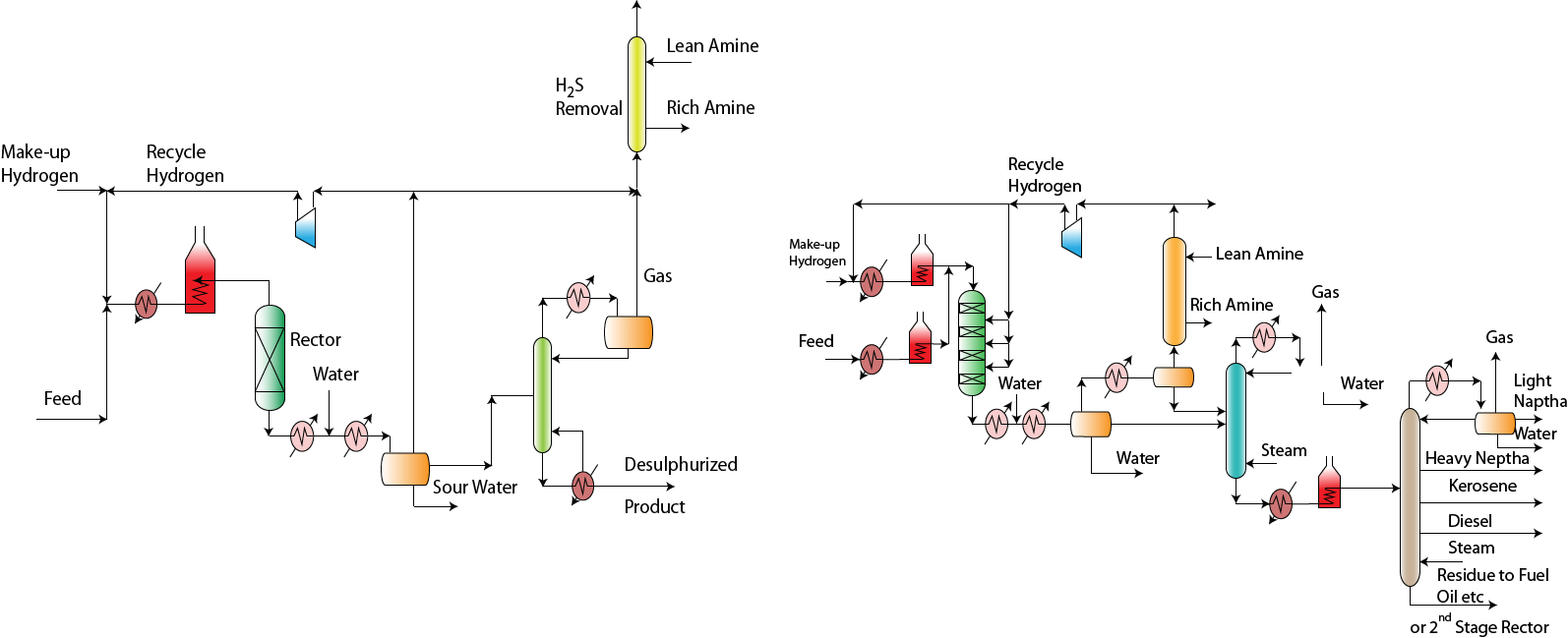 |
Figure 8.3 Flow sheet of hydrocracking
• The gas stream again enters a phase separator to remove entrained organic stream after cooling.
• The gas stream is subjected to H2S removal using amine scrubber. The organic stream eventually enters a steam stripper further stabilize the organic stream. In this fractionator, a gas stream and a sour water stream are generated.
• Eventually, the stabilized organic stream is sent to a multi-product fractionators to generate light naphtha, heavy naphtha, kerosene, diesel and residue. Steam is used to enhance the product quality.