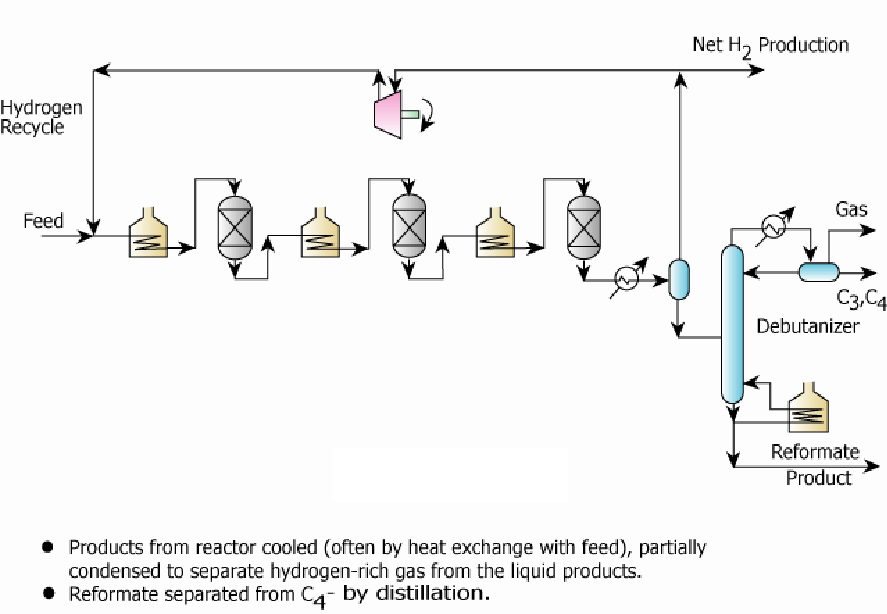
Figure 7.1 Reforming
7.1 Introduction
- • The catalytic cracking involves enhancing the octane number of the product
• Heavy naphthas are used are typical feed stocks
• The reaction is carried out on a catalyst
• Reforming reaction produces hydrogen as a by product which is used elsewhere in the refinery
• Usually Platinum supported on porous alumina is used as a catalyst
• Catalyst activity enhanced using chloride
7.2 Cracking Chemistry
- • Paraffin isomerisation takes place
• Naphthene isomerisation also takes place to produce cycloalkanes
• Cyclo alkanes undergo dehydrogenation to generate aromatics
• Dehydrocyclization takes places to convert side chained alkanes to cyclo alkanes and hydrogen
• In summary lower octane number feeds are converted to high octane products
• The reformate thus produced has high octane and aromatics (benzene, toluene and xylene) content.
• The reactions are endothermic. Therefore, heat needs to be supplied
7.3 Process technology (Figure 7.1)
- • The feed is mixed with recycled hydrogen
• Subsequently, it is heated before sending to reactor
• Since the reactions are highly endothermic, several combinations of reactor + heaters are used.
• The products from the final reactor are cooled. Often this is carried out with heat recovery principle in which heat is recovered using the fresh feed to the first reactor.
• After this, the product mixture enters a phase separator which separates the hydrogen gas stream from the liquid stream.
• The liquid stream from the phase separator is sent to a debutanizer distillation column that separates butanes and lower alkanes from the reformate product.
• The hydrogen produced in the phase separator is compressed and sent back to the first reactor.
• Excess hydrogen generated in the reactions is taken out as a bleed stream
• Catalyst regeneration (not shown in the flow sheet) needs to be carried out to regain catalyst activity. This can be in different modes of operation namely cyclic, semi-regenerative or continuous. When continuous mode of catalyst regeneration is carried out (as in UOP continuous catalytic reforming process), the moving bed designs are used for the reforming reactor. Additional complexity in the moving bed reactors is to enable process intensification to club the sequence of three reactors + heaters into one single unit.