7.3 Effect vapor flow conditions on tray design
7.3.1 Flooding consideration
Excessive liquid buildup inside the column leads to column flooding condition. The nature of flooding depends on the column operating pressure and the liquid to vapor flow ratio. It may be downcomer backup, spray entrainment or f roth entrainment type floodings. Higher tray pressure drop due to excessive vapor flow rates holds up the liquid in the downcomer, increases the liquid level on the plate and leads to downcomer flooding situation. The column flooding conditions sets the upper limit of vapor velocity for steady operation.
Gas velocity through the net area at flooding conditioncan be estimated using Fair's correlation ( [4], page 14-26 ):
 |
[m/s] | (7.1) |
ρv = vapor density, kg/m3
ρl = liquid density, kg/m3
σ = liquid surface tension, mN/m (dyn/cm)
 =
capacity parameter (m/s) can be calculated( [4] page 14-27 ) in terms of plate spacing and
=
capacity parameter (m/s) can be calculated( [4] page 14-27 ) in terms of plate spacing and
flow parameter  |
(7.2) |
L = liquid flow rate, kg/s
V = vpor flow rate, kg/s
The design gas velocities (Un) is generally 80-85% of  for non-foaming liquids and 75% or less for foaming liquids subject to acceptable entrainment and plate pressure drop.
7.3.2 Sieve tray weeping
Weeping occurs at low vapor/gas flow rates. The upward vapor flow through the plate perforations prevents the liquid from leaking through the tray perforation. At low vapor flow rates, liquid start to leak/rain through the perforation (called weeping). When none of the liquid reaches the downcomer at extreme weeping condition at very low vapor flow rate, it is called dumping. The weeping tendency increases with increasing fractional hole area and liquid flow rates.
The vapor velocity at the weep point (where liquid leakage through holes starts) is the minimum value for stable operation. For a chosen hole area,the minimum operating vapor flow velocity ( at minimum flow rate for stable operation should be above weep point vapor velocity.
The minimum vapor velocity ( ) at the weep point ( [3] page 569 ):
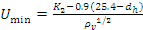 |
(7.3) |
Where, dh = hole diameter, mm,
ρv = vapor density, kg/m3 (maximum value of vapor density)
K2 = constant (K2) of weep-point correlation depends on the depth of clear liquid (weir crest + weir height) on the plate ( [3] page 571 ).