7.2.3 Sieve plate
The sieve tray (also known as perforated plate) is a flat perforated metal sheet (Figure 7.7). The hole diameter from 1.5 to 25 mm are very commonly used. The sieve tray layout is a typical square or equilateral triangular pitch holes. The gas/vapor flows upward through the perforation and disperses into the flowing liquid over the plate. There is no liquid seal in case of trays without downcomer and the liquid weeps (called weeping) through the holes at low flow rates, reducing the efficiency of plate. For this reason, sieve tray has the lowest turndown ratio. Sieve tray construction is simple and relatively cheap.
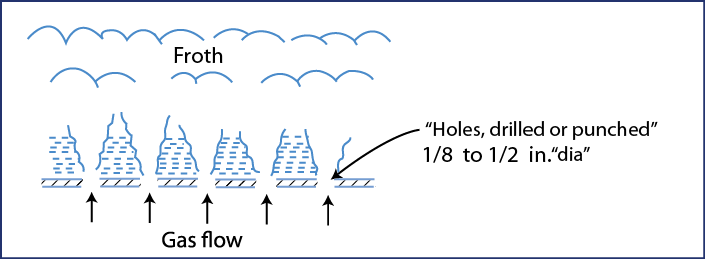
Figure 7.7 . Sieve tray ( [4] page 14-25 ).
7.2.4 Selection of tray type
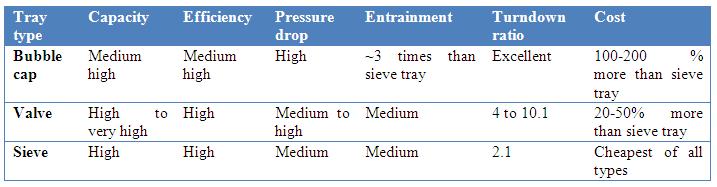
The comparative performances of three common types of trays are summarized in Table 7.1.
The capacity, efficiency, pressure drop and entrainment of sieve and valve trays are almost same.
Bubble cap trays have lower capacity and efficiency and but higher pressure drop and entrainment compared to valve and sieve trays. The turndown ratio comes in the order of: bubble cap>valve>sieve. However, valve trays have the best turndown ratio in case of refinery applications. Sieve trays are the least expensive and suitable for almost all applications. Valve trays can be considered where higher turndown ratio is needed. Bubble cap trays should be used at very low liquid flow rate which is not achievable using sieve trays.
Table 7.1: Comparison of three types of cross-flow trays ( [5] page 266 ).