Nano metal or metal oxide catalysts
Nano particles consisting of small metal or metal oxide crystallites in the range of few nanometers (1-100 nm) are important for catalysis and adsorption. Nanoparticles have higher effective surface area and improved physico-chemical properties giving better performance. Uniform shape and sized catalysts are particularly important for structure sensitive reactions where different type of surface metal atoms such as corners, edges or terrace atoms possesses quite different properties.
Menezes et al. [1] studied the effect of particle size on catalytic activity of titania supported Au-Ag (1:1) nanoparticles for CO oxidation. They observed that reactivity of the catalysts increased as size of the nanometals decreased. They reported turn over frequency of 0.02, 0.04 and 0.08 s-1 for nanoparticles having average size of 3,12 and 19 nm respectively.
Synthesis of nanoparticles
It is a challenge to prepare nanoparticles of uniform shape and size by conventional methods. Various new preparation methods are reported that give nanoparticles with narrow size distribution. Some of the reported methods are :
- Hydrothermal technique
- Microwave assisted synthesis
- Dendrimer assisted method
- Reverse micelle method
- Chemical vapor deposition
Hydrothermal method
In a hydrothermal process precursor solution, often in presence of an alkali, is autoclaved at certain temperature for specific time. In a typical process, aqueous solution of precursor and KOH is mixed and placed in teflon-lined stainless-steel autoclave. Autoclave is maintained at 70- 200°C for 10-24 h depending on process and then air-cooled to room temperature. Resulting precipitate is collected by filtration, washed and finally dried.
For example, nickel ferrite particles prepared by hydrothermal process resulted in particles of size distribution from 40-90 nm as reported by Cheng et al. [2].

Microwave-irradiated synthesis
Microwave irradiated synthesis method is a new promising technique for the preparation of size controlled metallic nanostructures. Xu et al. [3] reported preparation of Pt nanoparticles supported on CNTs. In this method solutions of Pt precursor (H2PtCl6. 6H2O), ethylene glycol and KOH are mixed in vial and CNTs are uniformly dispersed in mixed solution. Closed vial is then placed in microwave oven (2450 MHz, 800 W) and heated for the required time. The resulting suspension filtered and dried at 120°C. This preparation method resulted in Pt nanoparticles on surface of CNTs having uniform spherical shape with diameter of 15 ± 3 nm.
Dendrimer assisted synthesis
Dendrimer is highly ordered branched poly-amidoamine macromolecule with tree-like topology and is used in preparation of nano-material. Dendrimer have multiple coordination sites that are utilized to coordinate metal ions and synthesize metal clusters. In this method metal ions in solution are complexed to dendrimer, mostly with amine groups in the outer shell of OH-terminated poly-amidoamine. Complexed metal ions are subsequently reduced to metal atoms which agglomerate into metal particle. Men et al. [4] reported synthesis of dendritic polyphenylazomethines (DPA) dendron encapsulated gold clusters having average cluster diameter of 2.2 nm.
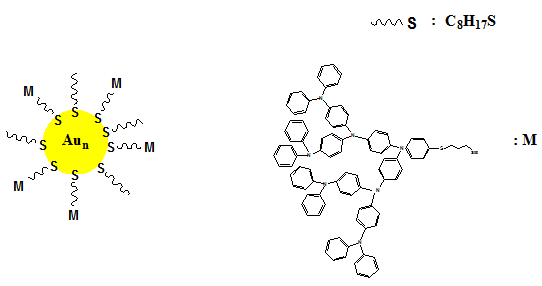
Fig 1. Gold clusters with DPA dendron