Extrusion:
It is a widely used technique. In this method, a suspension or paste of the catalyst powder is passed through a profiled die that determines the shape of the body. Screw extruders are very common in use. Slurry of the catalyst is fed to the extrudate at one end and the screw forces the slurry through the holes at the other end. As the ribbon of slurry emerges from the holes, a knife is arranged at the end to cut it to the required size. Particles of narrow size distribution can be obtained by this method.
Spray drying:
This process involves atomization of slurry feedstock into a spray of droplets and contacting the droplets with hot air in a drying chamber. Particle sizes are determined by the size of droplets, which is controlled by design of spray nozzles, slurry flow rate, slurry viscosities. Products in a spray dryer are spheres of diameters in the range of 0.05 to 0.5 mm.
The schematic diagram of catalyst formulation techniques are shown in Fig. 2.
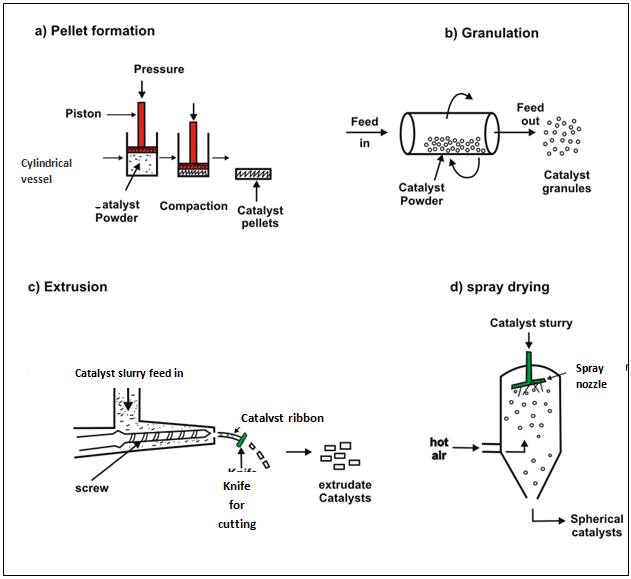
Fig. 2. Schematic diagram of different catalysts formulation techniques
Book References :
- K.P. de Jong., Synthesis of solid catalysts , Wiley –VCH, 2009
• J.T. Richardson, Principle of catalysts development, Plenum Press, 1989
• G. Ertl, H. Knozinger & J. Weitkamp, Handbook of Heterogeneous Catalysis, Vol 1, Wiley – VCH, 1997
• R. J. Farrauto & C. H. Bartholomew, Fundamentals of Industrial Catalytic Processes, Blackie Academic & Professional, 1997
• J.J. Carberry , Chemical and catalytic reaction Engineering, Dover Publications, 2001