The extent of change in the physical characteristics of the final sample depends on following parameters: temperature, heating rate, heating time and gaseous environment.
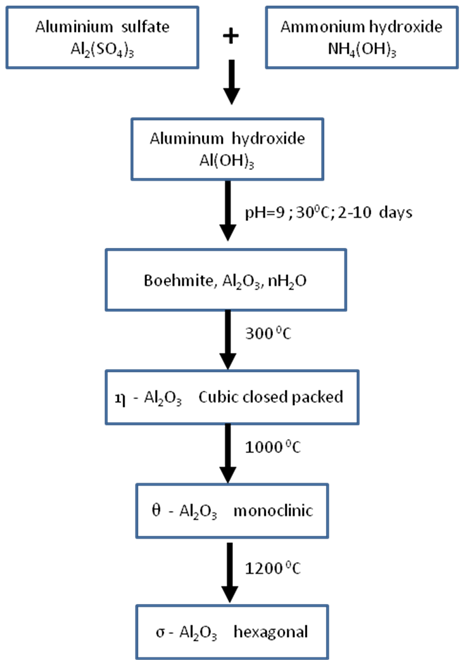
Fig. 1. Formation of various phases of alumina on calcination at different temperatures
Catalyst shaping and formulation
Mainly, solid catalysts are used in industrial catalytic processes and these are formulated in different forms such as pellets, extrudates, granules or sphere form.
Formulation and shaping of solid catalysts is done to:
- avoid high pressure drop in fixed and moving beds
- increase thermal resistance against sintering fracture or phase transition
- increase mechanical resistance against crushing and attrition
- ensuring high effective heat conductivity in fixed and moving bed for strongly exothermic and endothermic reactions
Aiming at highest catalyst efficiency is the primary objective in catalyst design because conversion, selectivity and thermal resistance are strongly affected by above mentioned parameters. Some of the common catalysts formulation techniques are :
- pellet formation
- granulation
- extrusion
- spray drying
Pellet formation:
It is a high pressure agglomeration technique producing particles of uniform shape and dimensions. Typically the dry catalyst powders are compressed in a dye by applying forces between 50-80 kN with a pending tool. Factors such as ultimate tensile strength of the materials , moisture content, porosity, stickiness are important. Some materials, such as kieselguhr, undergo easy pellet formation whereas other materials such as alumina require addition of small amount of plasticizers or lubricants such as graphite, talc etc. Important processing parameters are the maximum applied pressure and the rate of pressure rise. Both influence the hardness of the pellets as well as the integrity of compacted particles.
Granulation:
This is a size enlargement process by wet tumbling. In this method the particles are tumbled in a cylinder A cohesive liquid is sprayed onto the catalyst powder such that the wetted particles stick together. The granules grow by contacting further particles. Product with wide size distribution can be produced by controlling parameters such as binders type and concentration, rpm of pan, granulation time and angle of inclination of pan. Typically pan granulation yields spherical particles of diameter in the range of 2-20 mm.