Aim:
To check the purity of a protein or peptide using reversed-phase HPLC
Introduction:
HPLC is an acronym for high performance liquid chromatography or high pressure liquid chromatography. The columns that are used in HPLC are made up of very homogeneous small particles. Such columns show improved physical and chemical stability, faster separation, and better reproducibility compared to the traditional columns having soft gels. Very small, tightly packed particles offer a high resistance to the mobile phase flow; the mobile phase therefore needs to be pushed through the column at very high pressures (~500 – 5000 psi). The basic components of an HPLC system are shown in figure 26.1.
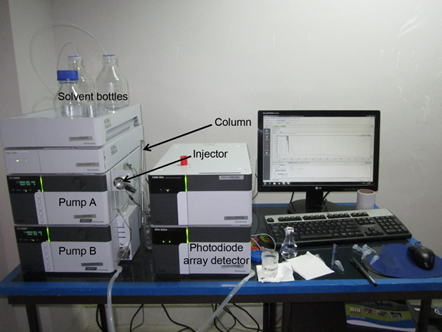
Figure 26.1: An HPLC instrument
- 1. Pumps:
-
a. The role of the pumps is to force the liquids into the column at desired flow rates, expressed as ml/min .
b. Flow rates between 0.5 – 2.0 ml are usually sufficient for most experiments.
c. Pumps in modern instruments can reach pressures in the range of 6000 – 9000 psi.
d. The pumps can be used for delivering either a constant (isocratic) or changing (gradient) composition of the mobile phase.
2. Injector:
a. Injector is used for introducing the sample into the mobile phase flow stream just before the column.
b. The injector is connected with a loop that determines the maximum volume of the sample that can be injected.
c. The samples are injected using a syringe; the samples can also be introduced into the system using an automatic injector, called an autosampler.
3. Column:
a Column is made up of very homogeneous small particles. Smaller particles provide more surface area and higher resolution.
b. As the particle size decreases, the pressure required for achieving optimum mobile phase flow increases.
4. Guard column (Optional):
a. Guard columns or column guards are the small versions of the analytical columns that are packed with the exactly same material.
b. They are placed between the injector and the column and collect any insoluble or particulate material present in the sample thereby increasing the column's life.
5. Detector:
a. An inline detector allows monitoring the chromatographic run in real-time.
b. Absorbance of light, fluorescence, and change in the refractive index caused by the analyte molecules are the most commonly used detection methods.
6. Fraction collector (Optional)
a. It collects the fractions of defined volume automatically.
b. It is completely an optional module as fractions can be collected manually.
7. Computer:
a. A computer controls all the modules of the HPLC system.
b. It processes the data, displays it in real-time, and stores it.