Aim:
To determine the molecular weight of a given protein using gel filtration chromatography
Introduction:
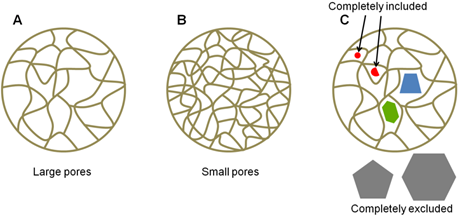
Gel filtration chromatography separates the molecules based on their size; it is therefore also known as size exclusion chromatography. The gel bed is made up of the beads; the beads themselves are made up of cross-linked three-dimensional network of molecules having pores (Figure 23.1). The porosity of the beads is determined by the extent of cross-linking of molecules. Molecules, that are smaller than the maximum pore size of the bead, can penetrate the beads. Molecules, that are smaller than the smallest pore, can penetrate all the pores and are said to be completely included. Similarly, the molecules that are larger than the largest pore, cannot enter any of the pores and are said to be completely excluded. It is therefore not possible to resolve the components that are completely included or completely excluded using size-exclusion chromatography. This defines the separation limits of a size exclusion column.
|
Figure 23.1 The diagrammatic representation of the beads with different porosities. Molecules completely included (shown in red) and completely excluded (shown in grey) are also shown in panel C. |
The molecules that are completely included elute at Vt while those that are completely excluded elute in the void volume, V0 .
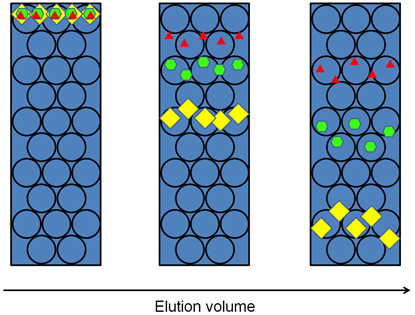
The extent to which the molecules enter the pores depends on both their shape and molecular weight. The molecules that lie in the separation regime i.e. those that are neither completely included nor completely excluded elute based on their molecular weight; the largest molecule elutes first while the smallest elutes last as shown in figure 23.2.
|
Figure 23.2: A diagram showing separation of molecules based on size in a gel filtration column |