Aim:
To determine the melting temperature (Tm) of a given DNA sample using ultraviolet absorption
Introduction:
The structure of DNA is briefly reviewed in lecture 1. A double-helical DNA is made up of two strands that run antiparallel to each other. Each adenine (A) in one strand is paired with a thymine (T) on the other; similarly, each guanine (G) on one strand is paired with a cytosine (C) on the other. A–T and G–C are said to constitute the complementary base pairs. This pairing is achieved through stacking interactions and hydrogen bonding between the bases and is the basis of the double stranded DNA structure and its stability. Heating disrupts these non-covalent interactions between the bases; this could unwind the two strands separating the two strands apart. Separation of the two DNA strands is termed as denaturation or melting of DNA. In the double-helical structure, guanine forms three hydrogen bonds with cytosine while adenine forms two hydrogen bonds with thymine. It is therefore evident that the amount of heat required for denaturing the DNA would depend on its nucleotide composition. The temperature at which 50% of the DNA gets denatured is termed as its melting temperature (Tm).
Nucleic acids absorb very strongly in the near UV region. The absorbance is attributed to the heterocyclic rings present in the nucleotides. At neutral pH, DNA would typically absorb with an absorption maximum around 260 nm. Denaturation of DNA leads to higher absorption of ultraviolet radiation (hyperchromicity) (Figure 7.1). The melting temperature of DNA can therefore be determined simply by monitoring its absorbance at 260 nm while heating it.
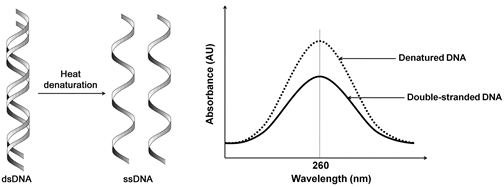
Figure 7.1: The hyperchromic effect in DNA; denaturation leads to higher absorption
Experimentally, the absorbance of the DNA molecule remains fairly constant at lower temperatures giving a plateau. As the temperature increases, the AT rich regions start melting thereby causing an increase in absorbance. Further increase in temperature causes steep rise in the absorbance followed by another plateau as the DNA gets completely denatured at these temperatures (Figure 7.2).
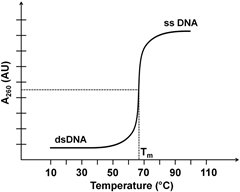
Figure 7.2: A typical DNA melting curve; the temperature at which half of the DNA is denatured is termed as the melting temperature (Tm).