26.4 Mechanism of Repair
In the cell free extract, mechanism of repair involves simple homology pairing wherein homology chimeric oligos pair with a plasmid target using DNA pairing enzymes and complexes. The mismatch between the gene and the chimera is recognized by the endogenous repair machinery that uses mismatch repair to correct the wrong nucleotide by using the chimera as the template sequence.
Figure 26.2 Working mechanism of chimeraplasty:
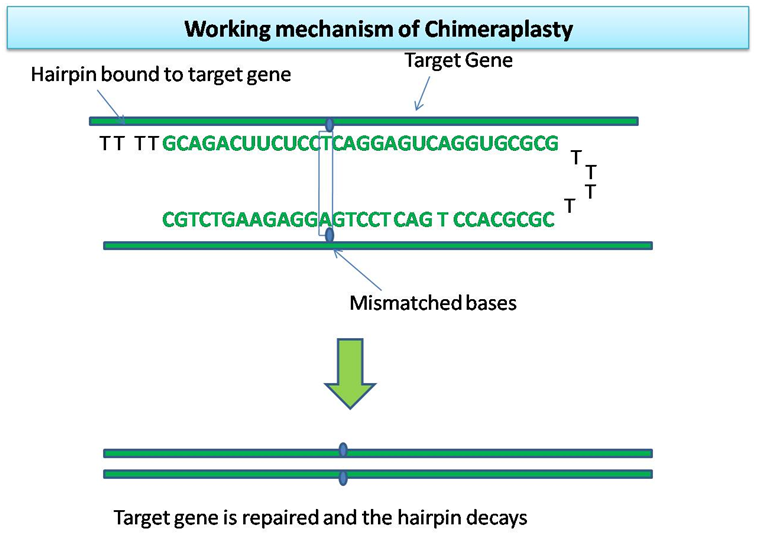
Once the target gene is repaired by the repair machinery, the chimera is no longer needed and decays, leaving only the corrected target DNA.
A successful in vivo repair study was carried out at the University of Arizona in Tucson by Li-Wen Lai by binding oligos to organ-specific ligands. Chimeric molecules can also be delivered to appropriate cells or tissue by liposomes, synthetic polymers and microscopic gold particles coated with the chimeric molecules (in plants). Once delivered inside the cell the oligos enter the nucleus where they specifically bind with the target DNA and invoke the mismatch repair mechanism that is performed by the cell's endogenous repair system. After the point mutation in the target gene is corrected the chimera decays.
As shown in the figure above, the chimeraplast appears like a paper-clip in which the double stranded stretch of DNA is flanked with short strands of RNA. The box shown in the figure has mismatched bases rest all the bases between the chimeraplast and the target gene are correctly matched. The incorporation of the chimera between the two DNA strands is enabled by the binding of the hairpin loop with the target gene. After successful base pairing of the chimeraplast with the target gene, the endogenous repair mechanism recognizes the mismatched bases and changes the bases of the target gene by using chimera as the template.
Thus, the endogenous repair system corrects the mismatch and repairs the target gene. After the correction of the point mutation in the target gene the hairpin of the chimera decays. As a result, the chimera dissociates and gradually decays leaving behind the repaired target gene.