·
26.2 Structure of the Chimeraplast:
A chimeraplast looks like a paper-clip shaped structure as shown in the figure below. It consists of a double-stranded DNA that is flanked with short strands of RNA.
Figure 26.1 Structure of a chimeraplast:
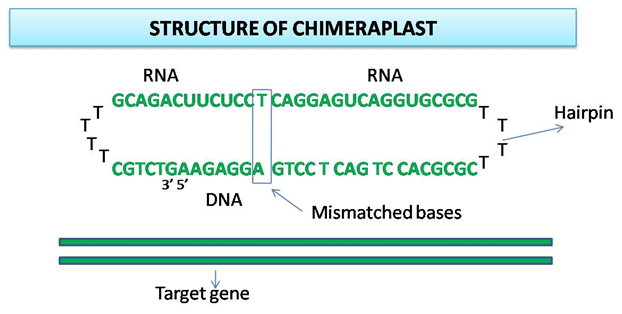
Hybrids of RNA and DNA have been found to actively participate in homologous pairing reactions, based on this concept the structure of chimeraplast was designed. The hairpin cap provides protection to the RNA-DNA chimera from exonucleases and cellular helicases. It also provides stability to the molecule and does not interfere in the base pairing of the RNA-DNA chimera molecule with the target gene. To provide protection to the RNA from cleavage by RNase H the ribose is methylated at the 2'-OH. The short RNA strands serve the purpose of activating the oligonucleotide ("oligo") for homologous recombination.
26.3 Design
To design a chimeric oligonucleotide the following steps are used:
- • Replicate a short portion of the base sequence of the target gene surrounding the base pair mutation (it should align perfectly with the gene, except for the one base pair where the mutation occurs).
• Substitute the correct base into the oligo at the place of mutation.
Thus, when the chimera inserts into the target DNA and pairs with the target gene, the mismatched base pair is recognized by the endogenous repair system. The change in sequence takes place either in the chimeraplast where the target DNA acts as a template or in the target DNA where the chimera acts as a template.