Figure 23.1 Schematic representation of development of cancer:
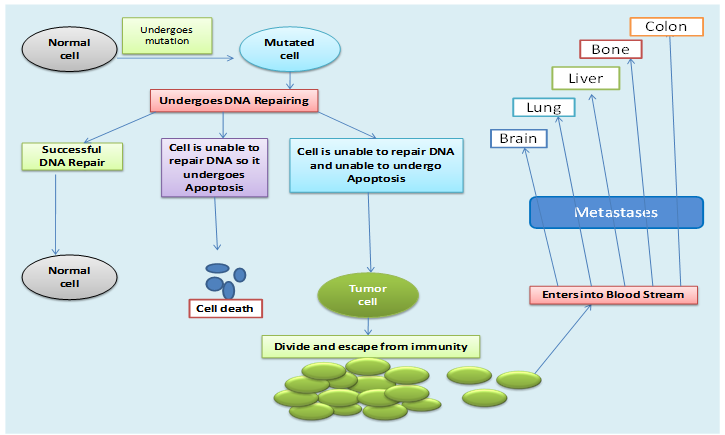 Gene therapy for cancer has generated great interest for more than a decade and intensive experimental and clinical investigations are in progress. By using gene therapy the gene of interest can be targeted to cancer cells or to normal tissue. It finds application for diagnosis as well as for treating the malignancy. The nature of cancer is quite difficult so based on the complex nature of cancer, these technologies involve complex strategies and principles like:
- • Immunomodulation
• Prodrug converting enzymes ‘‘suicide strategy'' (i.e., transfer of the cDNA of a prodrug converting enzyme)
• Tumor suppressor genes and anti-oncogenes involving gene replacement strategies such as transfer of a tumor suppressor and/or an anti-oncogene
• Tumorlysis by recombinant viruses or viral oncolysis
• Antiangiogenic and antiproteolytic gene therapy
• Drug-resistance genes (i.e., the delivery of drug-resistant genes into the hematopoietic precursor cells)
• Marker gene
Many of these experimental approaches are still being evaluated and more than 1300 trials have been published or are in progress. More than 780 of these trials are directed against cancer. Different types of cancer involve different strategies which are effective under specific clinical settings.