·
27.1 Virion properties
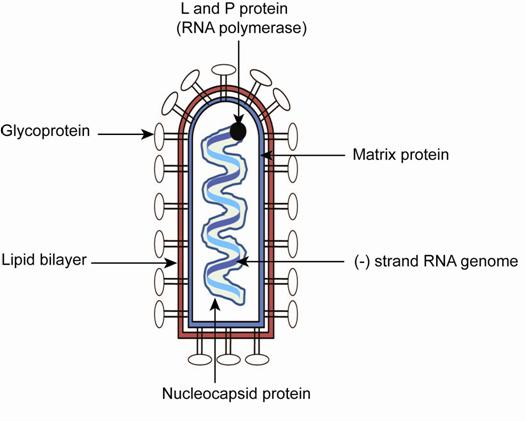
Rhabdoviruses contain a linear, single stranded, negative sense RNA genome. Virions are 45- 100 nm in diameter and 100- 430 nm long. The virion has a cylindrical nucleocapsid surrounded by an envelope with large glycoprotein spikes. The virions are sensitive to heat and UV rays but stable towards the changes in pH. The virus is bullet shaped which is due to its lipid envelope. The genome is 11.9 kb in size which encodes for 5 genes in the following order.
3' –N-P-M-G-L- 5'
N- Nucleocapsid protein
P- Phosphoprotein- cofactor of the viral polymerase
M- Inner virion protein/ helps in budding of the virion.
G- Glycoprotein that assists in making virion spikes
L- Large protein that represents RNA dependent RNA polymerase and helps in transcription and replication.
Figure 27.1 Schematic representation of rhabdovirus virion:
27.2 Virus Replication
In animals, virus replication takes place in the cytoplasm while in plants it may occur in nucleus. The virus entry into the host cell occurs by receptor mediated endocytosis followed by pH dependent fusion of virus envelope with endosomal membrane. As a result of fusion, the nucleocapsid is released into the cytoplasm. The first step of replication involves mRNA transcription from genomic RNA using RNA dependent RNA polymerase. For successful replication a large amount of nucleoprotein (N) and phosphoprotein (P) should be expressed. Switching of transcription to positive sense antigenome occurs after a threshold amount of N and P, which are then further used as a template for synthesis of negative stranded genomic RNA. There is a single promoter site at the 3' end of the viral genome where the polymerase attaches to the genomic RNA template and moves along the viral RNA. While moving it hits with start – stop signals at both the ends of the viral genes. Due to this only a small fraction undergoes continuous transcription process and hence this phenomenon is also known as attenuated transcription. Consequently more mRNA is produced towards the genes that are located at the 3' end and hence producing a gradient of mRNA in the order of N>P>M>G>L. As a result of the mRNA gradient, large amount of structural protein such as nucleocapsid protein is produced as compared to L protein.