25.4 Virus Replication
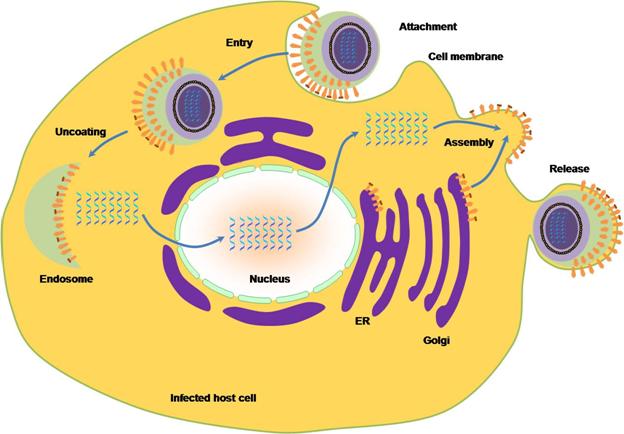
Influenza virus enters the cell after binding to sialic acid receptor present on the cell membrane. Different cells of the body contain different sialic acid receptor types which largely determine the host range of these viruses. The respiratory tract epithelium of humans contains α 2-6 linkage sialic acid receptor while birds contain α 2-3 sialic acid receptor. The types of sialic acid receptor in the epithelium determines the tropism of human as well as avian influenza viruses. A single amino acid change in the hemagglutinin protein [E (Glutamic acid) 190D (Aspartic acid)] changed the binding efficiency of influenza virus from α2,3 to α2,6 which caused the outbreak of 1918 influenza virus (Spanish flu). Virus enters the cell by receptor mediated endocytosis and uncoats under the low pH condition of endosome. RNA synthesis of influenza virus takes place in the nucleus of the cell. Nucleoprotein of influenza virus contains nuclear localization signals (NLS) that help in transportation of ribonucleoprotein complex into the nucleus. Negative sense RNA genome of influenza viruses serve as a template for the synthesis of positive sense RNA. Positive sense replicative intermediate RNA acts as a template for progeny RNA genome. Interestingly, viral endonuclease activity of PB2 protein cleaves the 5' cap and 10-13 nucleotides from a cellular mRNA in order to transcribe the viral RNA. The phenomenon is called as cap snatching . All orthomyxoviruses undergo splicing phenomena to produce two proteins from one gene such as influenza virus A uses gene segment 7 to produce M1 and M2 protein. Similarly 8 th segment of influenza virus produces NS1 and NS2 protein after undergoing splicing. In certain influenza viruses, frame shift mutation leads to formation of PB1-F2 protein. Viral protein synthesis occurs in the cytoplasm and its maturation takes place in endoplasmic reticulum and Golgi apparatus. Viral nucleoproteins are required for replication of genomic RNA which then enters the nucleus along with polymerase protein for transcription. Progeny virus is released by budding through the plasma membrane.
Figure 25.2 Schematic representation of an influenza virus replication cycle: