25.3 Virion properties
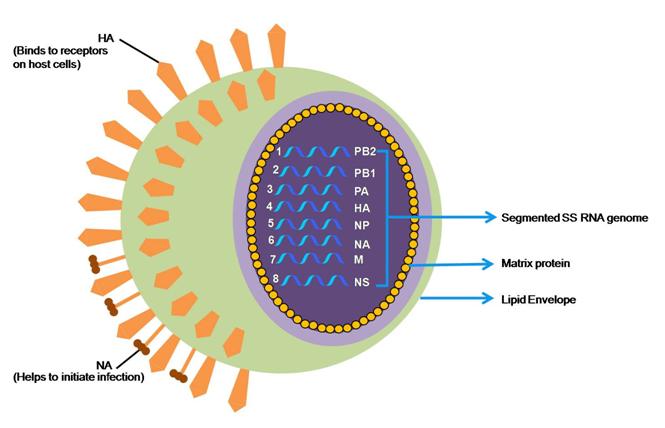
Orthomyxovirus virions are pleomorphic in shape and around 80–120 nm in diameter. The nucleocapsids are helical in symmetry and contains eight (influenza virus A, B, and isavirus), seven (influenza virus C), or six (Thogotovirus) RNA segments. Genome is single stranded negative sense RNA of 10 – 14Kb in size. The viruses also contain surface glycoproteins over the lipid envelope. The two envelope glycoproteins are hemagglutinin protein (H) and neuraminidase protein (N). There are 15 different subtypes of “H” and 9 different subtypes of “N”. This provides a total of 135 (15 x 9) possible combinations. Hemagglutinin is the most important protein of the virus and determinant of its virulence while neuraminidase helps in the budding and release of the progeny virions. Both hemagglutinin and neuraminidase frequently undergo genetic modifications decreasing the effectiveness of the host immune response. Influenza virus “C” lacks the “N” protein. Envelope is lined by Matrix protein “M1” and an ion channel matrix protein “M2”. Three proteins namely PB1, PB2 and PA form the viral RNA polymerase complex which is associated with genomic RNA and nucleoprotein.
Figure 25.1 Schematic representation of an influenza virus: