The molecules responsible for rejection of transplants are well known to be major histocompatibility complex (MHC). The alloantigen from a foreign donor is presented to the T cell by MHC molecules. The alloantigens are presented by typically two ways, direct and indirect.
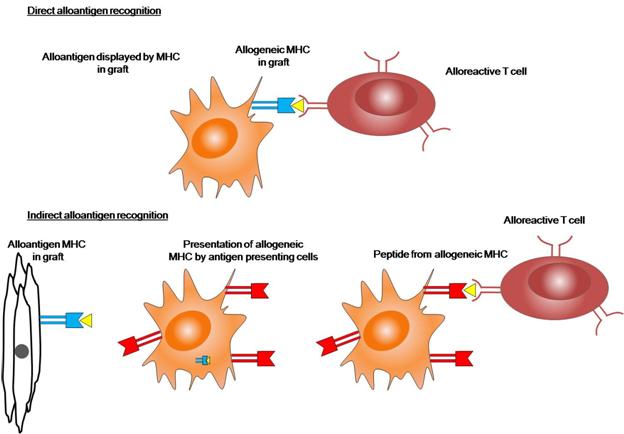
In direct presentation , MHC molecules from the donor is directly presented to host T cells to elicit the cell mediated immune response without the involvement of host antigen presenting cells or MHC molecule.
In indirect presentation , the alloantigens are captured and processed by host antigen presenting cells and presented to T cells to elicit the immune response.
Figure 31.2 Direct and indirect recognition of allogeneic antigens:
31.2 Activation of alloreactive lymphocytes
The alloantigens stimulate the B and T cell response similar to that of a protein antigen. Alloantigens can be recognized by T cells either by direct or indirect way and trigger a T cell immune response. Naïve lymphocyte migrates to lymph node after sensitization and differentiates into an effector cells that migrate back to the graft in order to induce rejection. Usually many of the T lymphocytes responding to alloantigens are memory T cells. In addition to alloantigen recognition by T lymphocyte, costimulatory molecules such as B7-1 also activate proliferation of lymphocytes. Similar to the processing of a protein antigen, the alloantigens that are processed by MHC class I can activate the CD8+ T cell response and those processed by MHC class II can activate CD4+ specific immune response.