24.3.2 The NF-AT pathway
The response generated to a T- cell is transmitted from the T cell receptor to a signal transducing complex called CD3 which is followed by clustering of CD3 chains in lipid rafts. Immunoreceptor tyrosine-based, activation motifs (ITAMs) are the specific amino acid sequences in the cytoplasmic domains of CD3 proteins. ITAMs later on become binding sites for several tyrosine kinases on activation. Zeta associated protein – 70 (ZAP-70) is one of the TKs and on phosphorylation can stimulate three signaling pathways. In the first pathway activation of calcineurin, a phosphatase is required and it ends up by generating NF-κβ and NF-AT . In the second pathway, ZAP-70 stimulates a protein kinase C which is required for activation of NF-κβ . The third pathway activates ras, a GTP-binding protein, fos and jun.
24.3.3 The JAK-STAT pathway
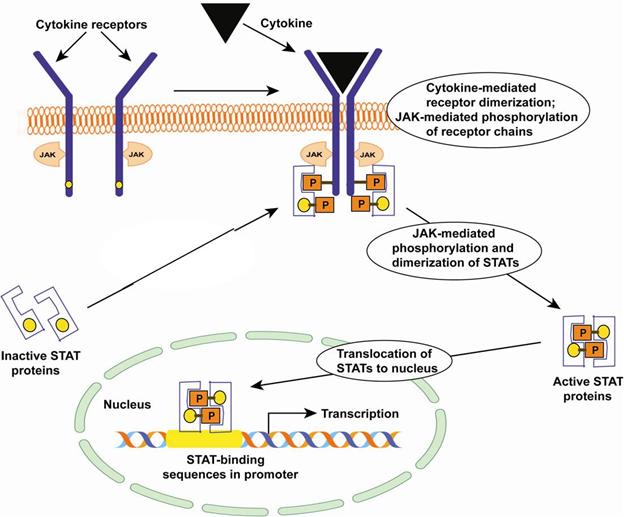
More than 40 cytokines use the JAK-STAT pathway. The stimulated JAK (Janus kinase) molecules phosphorylate tyrosine residues on one of several STAT proteins (signal transducers and activators of transcription). Phosphorylated STAT proteins then dimerize and dissociate from JAK and get shifted to the nucleus where they regulate the expression of target genes.
Figure 24.2 JAK-STAT signaling pathway:
Cytokine ligation to cytokine receptor leads to activation of JAK tyrosine kinase, phosphorylation of its cytoplasmic domain, and recruitment of STAT. Recruitment of STAT and its phosphorylation dimerizes and transport it to nucleus. This event activates the transcription of cytokine gene.