·
24.3.1 The NF-κβ pathway
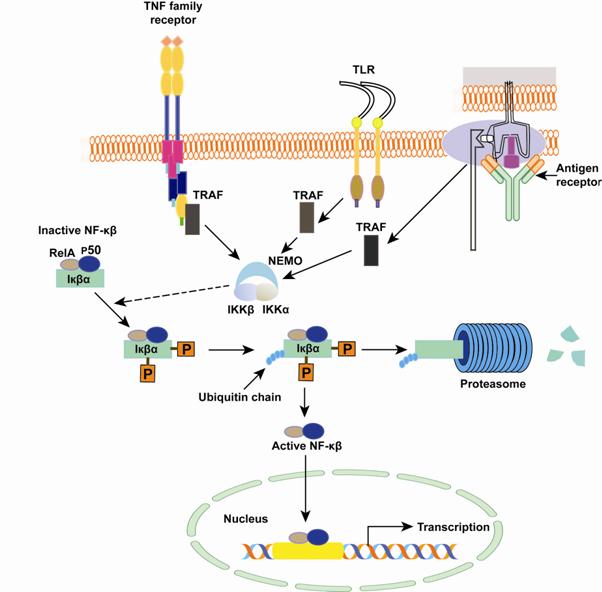
NF-κβ has its origins in the family of five transcription factors that play a crucial role in inflammation and immunity. There are more than 150 genes that get expressed on NF-κβ stimulation. There are three major pathways for NF-κβ activation. These are the classical pathway , alternative pathway and the third pathway that is stimulated by DNA damaging drugs and Ultraviolet light. The classical pathway involves proinflammatory signaling and gets activated by inflammatory cytokines, TLRs and antigen receptors (figure 24.1). IKK (Iκβ) complex is the central regulator of NF-κβ and all the signals induced by various stimuli focus on the same complex IKK. IKK complex is rich with kinase activity and on activation IKK complex phosphorylates Iκβ. Consequently Iκβ dissociates from the NF-κβ and the newly formed Iκβ becomes ubiquinated and is destroyed by proteasomes. Dissociation between Iκβ and NF-κβ liberates NF-κβ and it enters the nucleus to activate κβ motif containing promoters on DNA. This stimulates many genes and cytokines IL-1β, IL-6, IL-18, IL-33, TNF-α, GM-CSF, and IL-4. The second pathway or alternative pathway is required for lymphocyte development and is stimulated by a subset of TNF receptors. The third pathway does not require any IKK activation.
IKK- Iκβ kinase
Iκβ- Inhibitor of NF-κβ
NEMO- NF-κB essential modulator
TRAF- Tumor necrosis factor receptor-associated factor
Figure 24.1 NF-κβ signaling pathway: