·
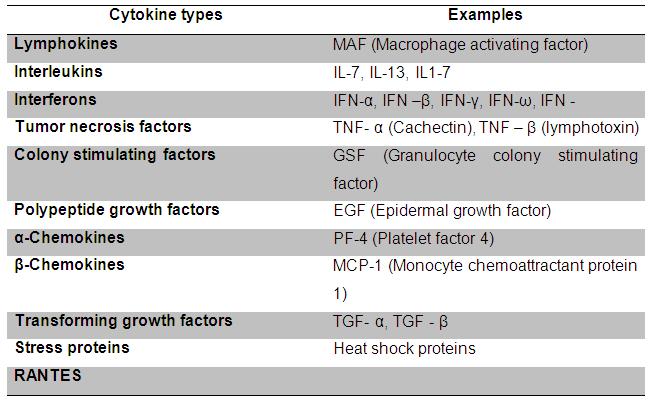
Table 23.1 Different cytokines and their examples:
23.3 Functions of cytokines
Cytokines are crucial regulators of cells and hence control their growth, movement, evolution and differentiation. Being responsible for so many factors they are generated in response to varied stimuli. The most critical of these stimuli are antigen-antibody complexes acting through antibody receptors (FcRs), pathogen-associated molecular patterns (PAMPs) such as lipopolysaccharides acting through toll-like receptors (TLRs) and antigens acting through the B cell or T cell antigen receptors. Cytokines acts on different cells and in different ways. Cytokines may have an autocrine effect (Cytokines bind to receptors that produced them), paracrine effect (Cytokines bind to receptors on neighboring or cells which are very close) or endocrine effect (Cytokines flow throughout the body) while acting on the target cells. Cytokines also play role in apoptosis and control various stages of replication. They have the capability for being sensitive markers of chemically induced perturbations in function, but this claim is not accepted from the toxicological point of view. The reasons behind this being that cytokines are released locally with plasma measures being unreliable and they have short half-lives which need precise timing to find.