·
9.2 MHC expression
MHC class I molecules are expressed on all the nucleated cells, while class II are expressed only in dendritic cells, B cells, macrophages and few other cells. Class I restricted CD8+ cells kill the virus infected cells, the cells containing intracellular antigens and tumor antigens. Class II restricted CD4+ cells kill the extracellular antigen presented by mostly dendritic cells. The expressions of MHC molecules are stimulated by the cytokines such as interferons (type-I and II). Interferon-γ secreted by natural killer cells during the early innate immune response is the major cytokine responsible for activating the expression of MHC class II molecules in dendritic cell and macrophages. The rate of transcription of MHC gene is the major determinant for the expression of MHC molecules. Any mutation in the transcription factor leads to many immunodeficiency diseases such as bare lymphocyte syndrome .
9.3 Properties of MHC molecules
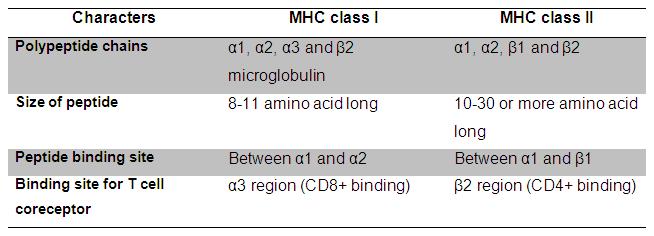
- 1. MHC molecule consists of peptide binding groove, an immunoglobulin like domain, transmembrane domain, and a cytoplasmic domain. MHC class I molecule is made up of one MHC encoded and one non-MHC encoded chain. MHC class II molecule is made up of two MHC encoded chains.
2. The peptide binding groove is located at the adjacent to polymorphic amino acid residue. Because of the variability in the region, different MHC molecule binds and displays different peptides and are recognized by different T cells.
3. An immunoglobulin like domains contains the binding site for CD4 and CD8 cells.
Table 9.1 Features of MHC class I and II molecules: