The major histocompatibility complex (MHC) was discovered from the studies conducted on transplant immunology. It was discovered from the fact that tissues exchanges between non-identical animal are rejected while from identical twins are accepted. George Snell and colleagues identified the single genetic region responsible for this rejection in chromosome 17 of mice and named it major histocompatibility complex. Similarly the gene responsible for graft rejection in humans was identified as human leukocyte antigen (HLA).
9.1 Major histocompatibility complex (MHC) gene
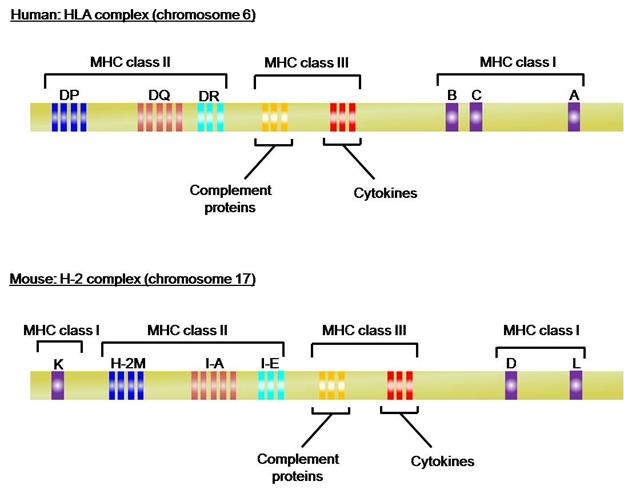
The MHC locus contains two types of MHC genes, class I and class II. MHC genes are codominantly expressed in an individual that means the alleles of the gene are inherited from both the parents. MHC class I molecules display peptides to the CD8+ lymphocytes to activate cell mediated immune response, and MHC class II molecules display the peptides to CD4+ lymphocytes to activate humoral mediated immune response. The diversity of the immune system has made MHC class I and II genes to be the most polymorphic genes present in the human genome. In humans, the gene responsible for encoding MHC molecule is located in the chromosome 6 (chromosome 17 in mice). The human MHC class I is encoded by three class of genes namely, HLA-A, HLA-B, and HLA-C. Similarly MHC class II is encoded by genes HLA-DP, HLA-DQ, and HLA-DR. In mice nomenclature for MHC changed to H-2K, H-2D, and H-2L for class I and I-A and I-E for class II (only 2 genes in mice). The set of MHC alleles present on each chromosome are called MHC haplotype .
Figure 9.1 Map of human and mice MHC gene loci: