·
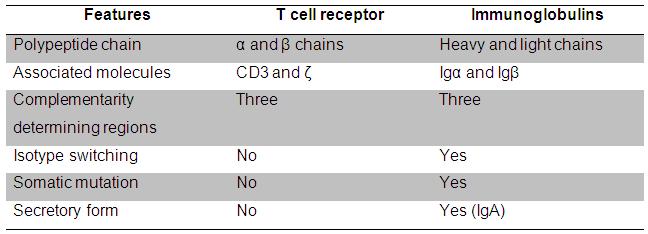
Table 14.1 Difference between T cell receptor and immunoglobulins:
14.2 Signaling in T cell receptor
The ligation of TCR with a peptide loaded MHC molecule results in grouping of CD3, ζ proteins and other coreceptors. CD4 and CD8 are T cell coreceptors that bind to the MHC molecule and facilitate the TCR signaling pathway. As we learned in MHC molecule CD4 recognizes class II while CD8 recognizes class I molecule, to maintain this equilibrium, T cells can express either CD4 or CD8 receptor but never both. The interaction of TCR with an MHC-peptide complex results in phosphorylation of the ITAM residue present over the TCR complex. Phosphorylation of the ITAM activates the tyrosine kinase which phosphorylates the tyrosine present over the other coreceptor molecules. The cytoplasmic tails of CD4 and CD8 recruits a Src family kinase Lck . Another Src family kinase associated with the TCR complex is Fyn . Lck phosphorylates the tyrosine in the ITAM present over the CD3 and ζ chain. The phosphorylated ITAM in the ζ chain recruits the Syk family tyrosine kinase called ζ associated protein of 70kD (ZAP70). ZAP70 in turn phosphorylates the adaptor proteins such as SLP-76 and LAT. Phosphorylated LAT then recruits several components of adaptor proteins including PLCγ1 (key enzyme involved in T cell activation). This entire event activates the Ras and mitogen activated protein kinase (MAPK) pathway which in turn activates the transcription factors and activated T cell response.