14.1 T cell receptor complex and T cell signaling
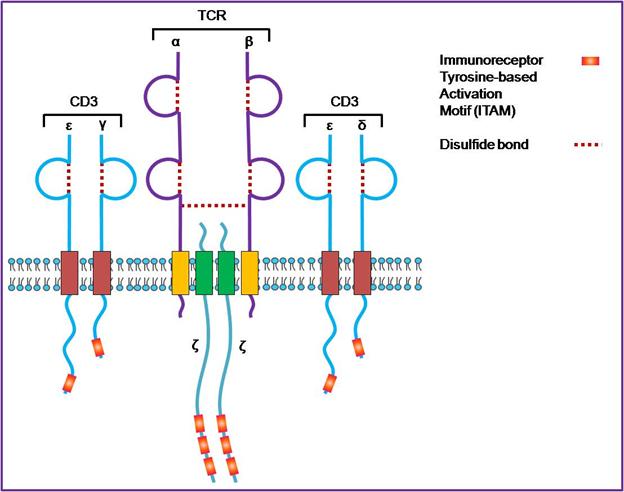
The T cell receptors (TCR) are made up of heterodimer of two polypeptide chains, α and β that are covalently linked with each other by a disulfide linkage. The TCR containing these two chains are called as αβ T cells. Another type of TCR called γδ T cells contains γ and δ polypeptide chains. Each polypeptide chain in TCR is made up of amino terminus, variable and carboxy terminal, constant region (similar like immunoglobulin molecules). The variable regions are the complementarity determining regions in the TCR and are responsible for its polymorphism. The α and β chains contain 5-12 amino acids residue at their cytoplasmic tail to take part in signal transduction pathway. The other two structures that are associated with the TCR are CD3 and ζ proteins which are noncovalently associated with the αβ chain. TCR together with CD3 and ζ proteins forms the TCR complex .
The CD3 and ζ proteins are constant in all T cells regardless to its specificity towards any ligand. CD3 contains ε, γ, and δ polypeptide chains which resembles the immunoglobulin superfamily members. CD3 contains two heterodimer made up of εγ and εδ polypeptide chains. The ε, γ, and δ polypeptide chains of CD3 molecule is made up of 44-81 amino acids and contains one ITAM molecule for modulating the downstream signaling pathway. CD3 polypeptide chain contains a negatively charged aspartic acid residue that interacts with the positive charged residue present in the αβ chain. The ζ polypeptide chain contains a long cytoplasmic tail that contains three ITAM molecules and usually expressed as a homodimer in a TCR complex.
Figure 14.1 T cell receptor complex: