1. Introduction
Biotransformation is chemical reactions catalyzed by cells, organs or enzymes. It is defined as a process through which the functional groups of organic compounds are modified by living cells to a chemically different product. Biotransformation explores the unique properties of biocatalysts, namely their stereo-and region-specificity and their ability to carry out reactions at no extreme pH values and temperatures. Biotransformation may be used to carry out specific conversions of complex substrates using plant, animal or microbial cells or purified enzymes as catalyst. Biotransformation is different from biosynthesis where complex products are assembled from simple substrates by whole cells, organs or organisms. They are also different from biodegradations in which complex substances are broken down to simple ones. Biotransformation has great potential to generate novel products or to produce known products more efficiently. The production of food metabolites, fine chemicals and pharmaceuticals can be achieved by biotransformation using biological catalysts. Cell suspension cultures, immobilized cells, hairy root cultures can be useful for the production of food additives and pharmaceuticals by biotransformation process. Plant cells for biotransformation purposes are selected because of two main reasons. Plant cells are usually able to catalyze the reactions stereospecifically, resulting in chirally pure products. They can carry out regiospecific modifications that are not easily carried out by chemical synthesis or by microorganisms. These reactions include reduction, oxidation, hydroxylation, acetylation, esterification, glucosylation, isomerization, methylation, demethylation, epoxidation, etc.
However, for a successful and viable process, the following prerequisites must be met
- The culture must have the essential enzymes.
- The substrate or precursor must not be toxic to the cell culture.
- The substrate must reach the appropriate cellular compartment of the cell.
- The rate of product formation must be faster than its further metabolism.
2. Biotransformation using plant cells and organ cultures
The biotransformation rates by plant cells and organs are depend on a variety of factors including the solubility of precursors, the amount of enzyme activity present, localization of enzymes, presence of side reactions producing undesired byproduct and presence of enzymes degrading the desired product. Elicitation, permeabilization, pH variation and osmotic effects can also influence biotransformation capacity of cells. Some examples of biotransformation reactions performed by in vitro plant cell and organ cultures are given below:
Peganum harmala cell culture converted geranyl acetate to geraniol and linalyl acetate to linalool and α-terpineol.
The alkaloid nitrosamine, which contains seven stereogenic centers, is present in Nitraria schoberi as a racemate. Isolation of a chiral metabolite might be due to spontaneous nonenzymatic reactions starting from an achiral precursor followed by enzyme-catalyzed metabolism of one of the enantiomers.
Catharanthus roseus suspension cell cultures can oxidize the phenylsulphonyl group from completely synthetic molecules to phenylsulfonyl derivatives.
Biotransformation of cinobufagin by C. roseus cell suspension cultures is shown in Figure 38.1.
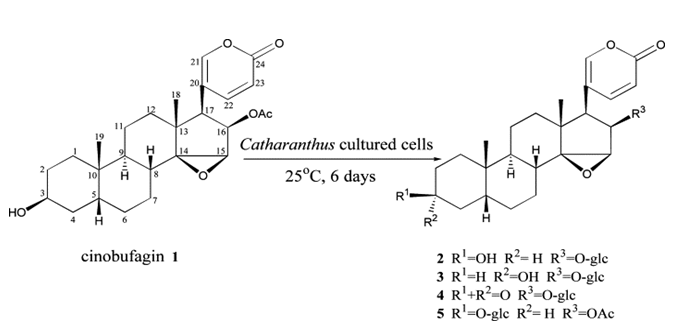
Figure 38.1: Biotransformation of cinobufagin by C. roseus cell suspension cultures