2.2. Cell cytotoxicity assays
Cytotoxicity assays are used by the pharmaceutical industry to screen for cytotoxic compounds. Cell membrane integrity is one of the most common methods to measure cell viability and cytotoxic effects. Compounds having cytotoxic effects often have compromised cell membrane integrity. Cytotoxicity can be monitored using the MTT or MTS assay. The aqueous extract isolated from in vitro derived cell cultures, raised from leaf-discs of Lantana camara, exhibited promising anti-proliferative activity on HeLa cells (Figure 34.2, 34.3). The minimal activity of the extract on normal BHK-21 cells verifies it's potential as a feasible anti-cancer agent.
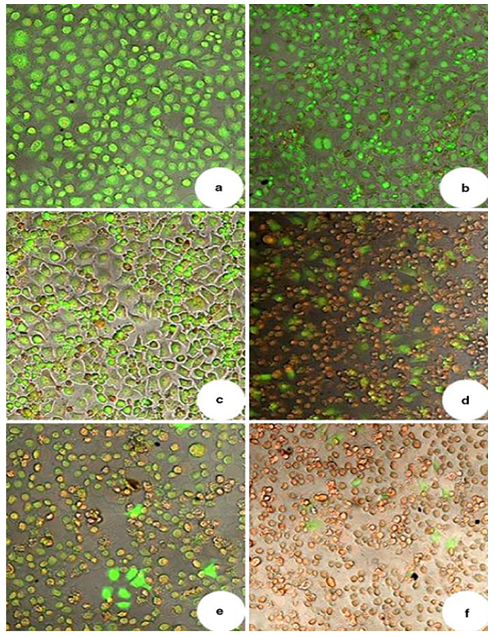
Figure 34.2: HeLa cells are stained with Acridine Orange/Ethidium Bromide and viewed under confocal laser scanning microscope. a. Control healthy cells, b. HeLa cells treated with aqueous extract of L. camara for 24 h showing bright green nuclei indicating initiation of chromatin condensation, c. same as b , treated for 36 h, showing zones of cleared monolayer, d, e and f. same as b, treated for 48, 60 and 72 h, respectively, showing gradual increase in frequency of dead cells taken the orange color.

Figure 34.3: Morphological observations of HeLa and BHK-21 cells under light microscopy.
a. untreated HeLa cells, b. HeLa cells treated with aqueous extract of L. camara , showing rounded apoptotic bodies, c. HeLa cells treated with curcumin, showing similar cell death patterns as in b, d. untreated BHK-21 cells, e. BHK-21 cells treated with aqueous extract of L. camara, showing low frequency of apoptotic bodies when compared to HeLa cells, f. BHK-21 cells treated with curcumin, showing similar cell death patterns as in e.