1. Introduction
Plant tissue culture can be defined as the in vitro manipulation of plant cells and tissues and is a keystone in the foundation of plant biotechnology. It is useful for plant propagation and in the study of plant growth regulators. It is generally required to manipulate and regenerate transgenic plants. Whole plants can be regenerated under in vitro conditions using plant organs, tissues or single cells, by inoculating them in an appropriate nutrient medium under sterile environment. Plant tissue culture relies on the fact that many plant cells have the capacity to regenerate into a whole plant–a phenomena known as totipotency. Plant cells, cells without cell walls (protoplasts), leaves, or roots can be used to generate a new plant on culture media containing the necessary nutrients and plant growth regulators. Plant tissue culture was first attempted by Haberlandt (1902). He grew palisade cells from leaves of various plants but they did not divide. In 1934, White generated continuously growing cultures of meristematic cells of tomato on medium containing salts, yeast extract and sucrose and vitamin B (pyridoxine, thiamine and nicotinic acid) and established the importance of additives. In 1953, Miller and Skoog, University of Wisconsin – Madison discovered Kinetin, a cytokine that plays an active role in organogenesis. Plant cell cultures are an attractive alternative source to whole plants for the production of high-value secondary metabolites.
2. Advantages of plant tissue culture over conventional agricultural production
The most important advantage of in vitro grown plants is that it is independent of geographical variations, seasonal variations and also environmental factors. It offers a defined production system, continuous supply of products with uniform quality and yield. Novel compounds which are not generally found in the parent plants can be produced in the in vitro grown plants through plant tissue culture. In addition, stereo- and region- specific biotransformation of the plant cells can be performed for the production of bioactive compounds from economical precursors. It is also independent of any political interference. Efficient downstream recovery of products and rapidity of production are its added advantages (Figure 31.1).
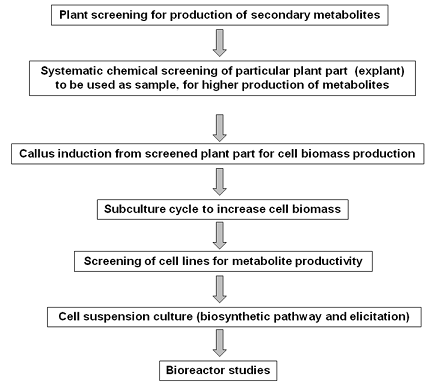
Figure 31.1: Steps involved in the production of secondary metabolites from plant cell
3. Plant secondary metabolites
Plant products can be classified into primary plant metabolites and secondary metabolites. Primary plant metabolites are essential for the survival of the plant. It consists of sugars, amino acids and nucleotides synthesized by plants and are used to produce essential polymers. Typically primary metabolites are found in all species within broad phylogenetic groupings, and are produced using the same metabolic pathway.
Secondary metabolites are the chemicals, which are not directly involved in the normal growth and development, or reproduction of an organism. Secondary metabolites are not indispensable for the plants but play a significant role in plant defense mechanisms. Primary metabolites essentially provide the basis for normal growth and reproduction, while secondary metabolites for adaptation and interaction with the environment. The economic importance of secondary metabolites lies in the fact that they can be used as sources of industrially important natural products like colours, insecticides, antimicrobials, fragrances and therapeutics. Therefore, plant tissue culture is being potentially used as an alternative for plant secondary metabolite production. Majority of the plant secondary metabolites of interest to humankind fit into categories which categorize secondary metabolites based on their biosynthetic origin. Secondary metabolism in plants is activated only in particular stages of growth and development or during periods of stress, limitation of nutrients or attack by micro-organisms.
Plants produce several bioactive compounds that are of importance in the healthcare, food, flavor and cosmetics industries. Many pharmaceuticals are produced from the plant secondary metabolites. Currently, many natural products are produced solely from massive quantities of whole plant parts. The source plants are cultured in tropical, subtropical, geographically remote areas, which are subject to drought, disease and changing land use patterns and other environmental factors.