3.2. Mode of differentiation
Regenerants may differentiate either directly from the explants or indirectly via callusing. Dedifferentiation favours unorganized cell growth and the resultant developed callus has meristems randomly distributed in the callus (Figure 4.2). Most of these meristems, if provided appropriate in vitro conditions, would differentiate shoot-buds, roots or embryos.
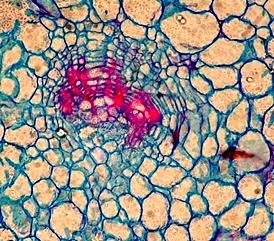
Figure 4.2: Meristem formation in callus. Thick tracheidal cells (stained red) are surrounded by cambium like cells (stained blue)
4. Trouble shooting
- • Few explants exude dark colored compounds, like phenols, pigments etc which leach into the medium from the cut ends of the explant. It results in the browning of tissues and the medium as well. The browning of medium is associated with poor culture establishment and low regeneration capacity of the explants. This can be overcome by:
-
i. minimizing the wounding of explants during isolation and surface disinfection to reduce this browning response.
ii. washing or incubation of explants for 3-5 hrs in sterile distilled water to remove phenolics responsible for browning of medium or explants.
iii. frequent subculture of explants with excision to fresh medium at regular intervals.
iv. initial establishment of cultures in liquid medium and later transfer to the semi-solid medium.
vi. culture of explants on porous substrate or paper bridges.
vi. addition of activated charcoal (AC) or polyvinylpyrrolidone (PVP) for adsorbtion of phenolics.
vii. antioxidants like ascorbic acid, citric acid etc. can also be used to prevent browning of tissues in culture.
• Appearance of vitrified tissues (hyperhydricity), a physiological disorder occurring in the in vitro cultures due to which the tissues look transparent and fluffy resulting from excessive intake of water. Hyperhydricity can be caused by a high concentration of cytokinin or low concentration of gelling agent or high water retention capacity of explants if the container is tightly closed.
• Loss of regeneration ability in long-term cultures due to epigenetic variations (temporary variations) and culture aging, including transition from juvenile to mature stage. Epigenetic variation are phenotypic temporary variations which disappear as soon as the culture conditions are removed.
• Genotypic variations are also seen in the cultures, therefore, cytological, biochemical and molecular analyses are required to confirm clonal fidelity of in vitro regenerants. Besides, morphological and physiological testing is also required to remove undesired genetic variability.