2.4. Factors affecting vascular tissue differentiation
Vascular differentiation is majorly affected qualitatively and quantitatively by two factors, auxin and sucrose. Cytokinins and gibberellins also play an important role in the process of xylogenesis. Depending upon the characteristics of different species, concentration of phytohormones, sucrose and other salt level varies and accordingly it leads to the vascular tissue differentiation.
3. Micropropagation techniques
3.1. Strategies for propagation in vitro
Typical micropropagation system can be broadly divided into five distinct stages (Figure 4.1):
- The stage zero is the selection of mother plant and preparation of explant.
The first stage is the initiation of a sterile culture of the explant in a particular enriched medium for specific species.
The second stage includes initiation of cell division from almost any part of the plant system to initiate regeneration or multiplication of shoots or other propagules from the explant. Adventitious shoot proliferation is the most frequently used multiplication technique in micropropagation systems. The culture media and growth conditions used in second stage need to be optimized for maximum rate of multiplication.
The third stage is the development of roots on the shoots to produce plantlets. Specialized media may or may not be required to induce roots, depending upon the species.
The final or the fourth stage is to produce self-sufficient plants. This stage usually involves a hardening-off process and acclimatization of plants in soil under green-house conditions for later transplanting to the field.
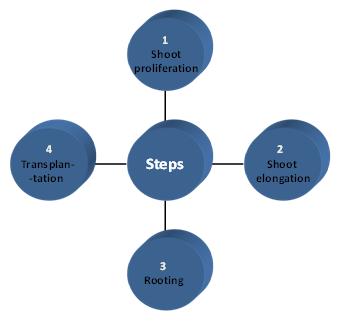
Figure 4.1: Micropropagation stages