Mutant Isolation
- How can you tell if there are any mutant colonies in a culture? This is done by either positive (direct) selection or by negative (indirect) selection.
- Positive Selection:
- Positive selection entails growing the culture on a medium that will allow for the growth of only the mutant colonies.
- If, for example, we want to find mutants that resistant to penicillin, we grow the culture on a medium that contains penicillin. Only those colonies that are resistant to penicillin will grow and we can identify them directly.
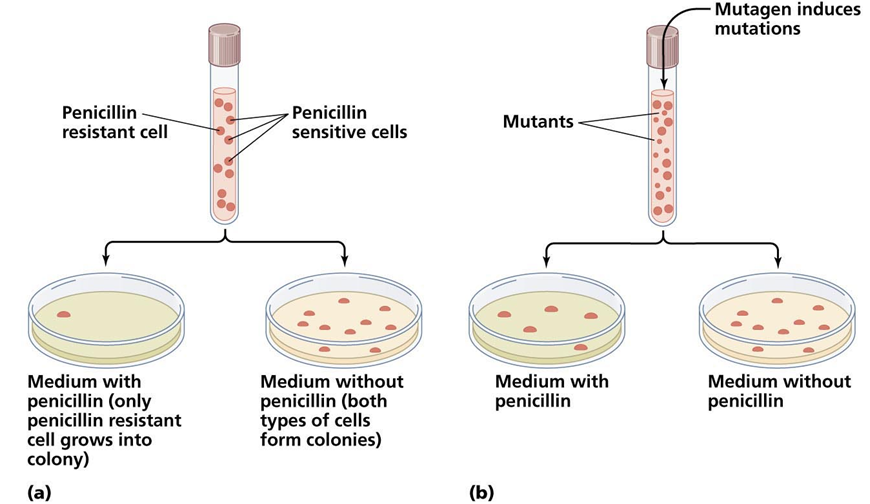
Fig. 39. Mutant isolation
- Negative Selection:
- Negative selection is used to identify mutants that have lost the ability to perform a certain function that their parents had.
- Auxotrophic mutants, for example, are bacteria that have lost the ability to synthesize an essential nutrient.
- The replica-plating technique is used to identify mutants by negative selection.
- the replica-plating technique can be used, for example, to identify mutants that have lost the ability to synthesize the amino acid histidine. Therefore, mutants are His- and require histidine in order to survive.
- Inoculate a histidine enriched medium with bacteria. Incubate so that cells can form colonies. This is the master plate.
- Press a sterile velvet surface into the colonies of the master plate. Some cells from each of the colonies adhere to the velvet.
- Prepare two mediums, one with histidine, the other without histidine.
- Transfer cells from the velvet to each plate.
- Compare growth on the two plates after incubation. Colonies that grow on the histidine enriched medium but not on the medium lacking histidine are His- mutants
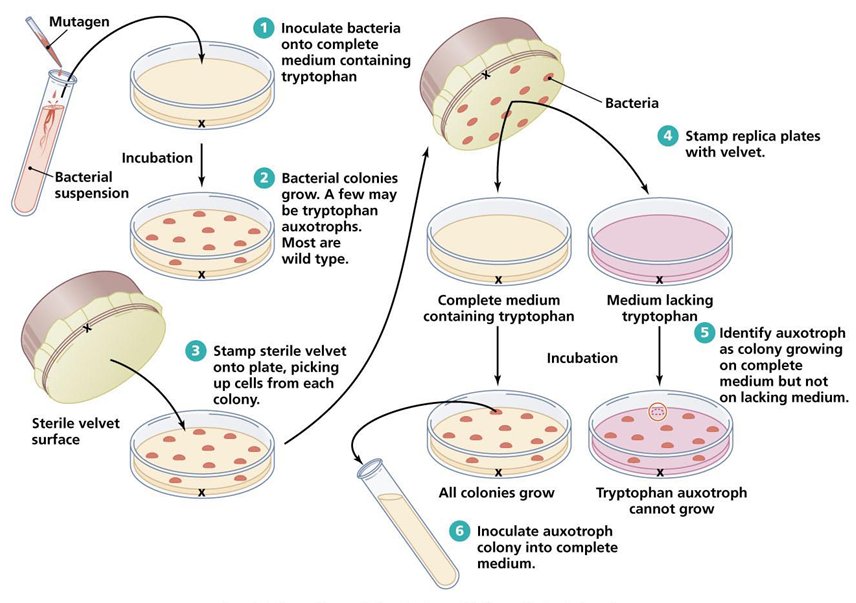
Fig. 40. Negative selection
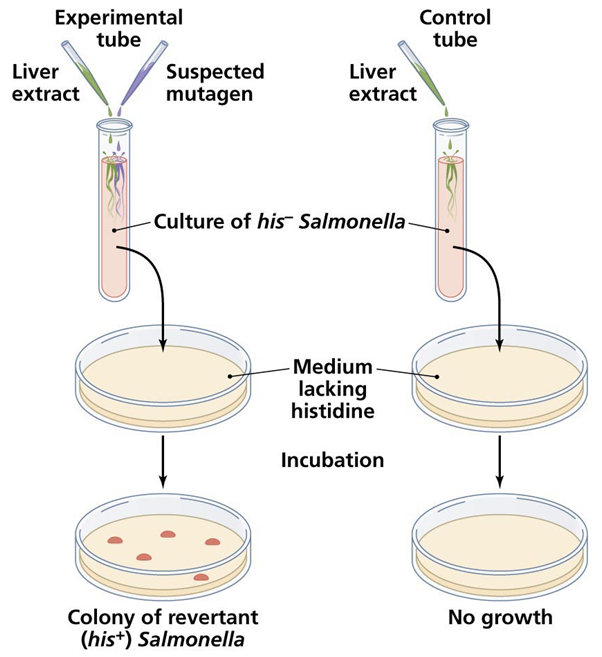
Fig. 41. Ames test
The Ames Test utilizes a histidine auxotroph of Salmonella to determine if a chemical agent is a mutagen. Though some spontaneous back mutations (a reversion back to the strain of Salmonella that can synthesize histadine) can occur, if many colonies of the microbe appear on the minimal plate after the addition of the test chemical, this is an indication the the chemical is a mutagen.
REFERENCES:
Text Books:
1. Jeffery C. Pommerville. Alcamo's Fundamentals of Microbiology (Tenth Edition). Jones and Bartlett Student edition.
2. Gerard J. Tortora, Berdell R. Funke, Christine L. Case. Pearson - Microbiology: An Introduction. Benjamin Cummings.
3. J. Krebs, E.S. Goldstein, Stephen T. Kilpatrick. Lewin's Genes X. Jones and Bartlett Publishers.
Reference Books:
1. Lansing M. Prescott, John P. Harley and Donald A. Klein. Microbiology. Mc Graw Hill companies.