Frameshift Mutations: One or 2 nucleotide pairs are inserted into or deleted from the molecule, causing an alteration of the reading frame. As the result of this shift, codons downstream of the insertion or deletion site specify an entirely new sequence of amino acids. Depending on where the insertion or deletion occurs in the gene, different effects can be generated. In addition to producing an entirely new polypeptide sequence immediately after the change, frameshift mutations usually produce a stop or termination codon within a short distance of the mutation. This codon terminates the already altered polypepetide chain. A frame shift in a gene specifying an enzyme usually result in a loss of enzyme activity. If the enzyme is an essential one, the effect on the organism can be disastrous.
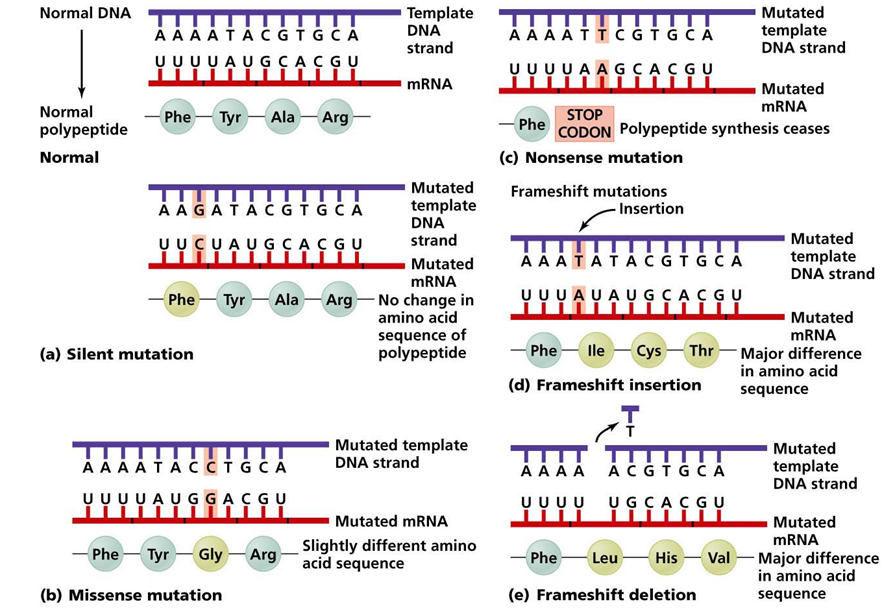
Fig. 38. Types of mutations
Mutation in non-coding DNA
They will have a phenotyping effect if it occurs in
- Regulatory elements (e.g. TATA box) → affect level of gene expression
- Splicing of introns: highly conserved GT & AG at the end of introns
Either:
- coding sequences being lost
- intronic sequences being added to the mRNA
Functional effects of Mutation on the Protein
- Loss of function
- Gain of Function
Loss of Function
- Reduce in activity
In heterzygous state → half normal levels of the protein product
- Or complete loss of the gene product
Gain of Function:
- Increased levels of gene expression
- Development of a new function(s) of the gene product
Chromosomal Mutations:
Chromosomal mutations are grouped into four broad types:
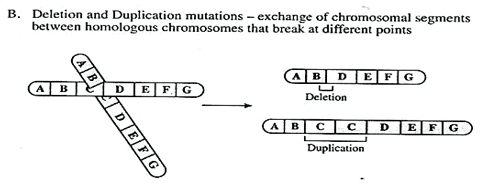
- Deletion: are chromosomal changes in which one or more genes or segments of chromosomal DNA are lost.

- Duplication: are chromosomal changes in which one copy or more copies of a gene are present on the same chromosome
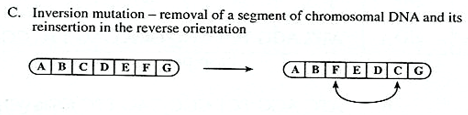
- Inversion: in which a segment of DNA is released and rotated 180 degrees before being reinserted into the DNA. If the inverted DNA segment carries part of the protein-coding sequence, the resulting protein would be drastically altered and most likely nonfunctional.
-
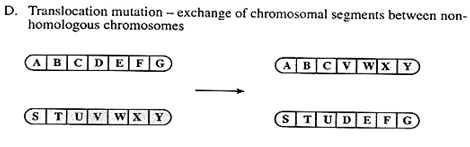
Translocation: occur when a segment of DNA moves from one chromosome and inserted into a different nonhomologous chromosome. Translocation can also be reciprocal, that is two nonhomologous chromosome may break and trade pieces of DNA. Translocation mutations frequently cause problems in meiosis and sometimes lead to aneuploidy (the gain or loss of chromosome)