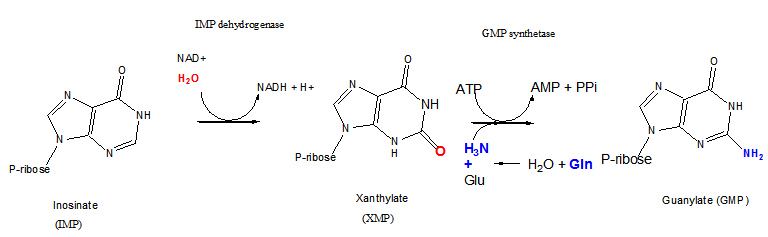
1. Formation of guanylate (GMP). Inosinate is first oxidized to xanthylate, and the C-2 carbonyl is then converted to an amino group
 Regulation of Purine Biosynthesis:
- • AMP, GMP and IMP are feedback inhibitors of purine biosynthesis
- 1. PRPP synthesis is inhibited by AMP, IMP, GMP (indicators of poor energy status)
• Purine biosynthesis is energetically expensive (6 moles ATP used per 1 mol IMP)
• Nucleotide concentrations are tightly regulated in a cell. Loss of regulation may lead to clinical disease (e.g. gout).
2. The committed step (phosphoribosylamine formation) is inhibited by all purine mononucleotides.
3. AMP and GMP inhibit their own synthesis from IMP nucleotide Reciprocal substrate regulation balances the relative purine levels:
AMP synthesis requires GTP as the energy source
GMP synthesis requires ATP as the energy source
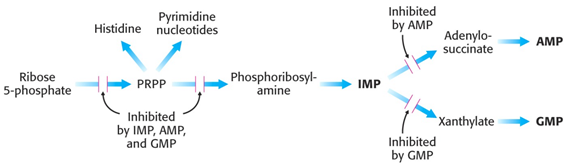
Fig. 32 . Regulation of purine biosynthesis