Step 4: The inner amide group is converted to an amidine by the replacement with ammonia derived from glutamine:
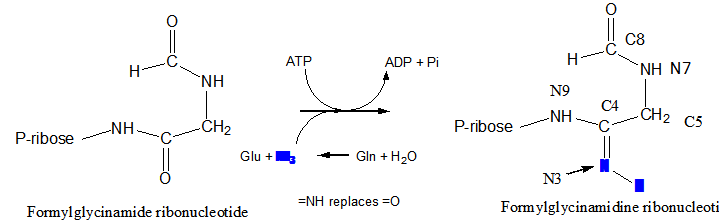
Note: Steps 1-4 are catalyzed by a multienzyme complex. Many of the intermediates in purine biosynthesis are unstable in aqueous solution and only exist in solvent protected environment. The formation of multienzyme complexes makes it possible to internally channel the product of one reaction to the next catalytic center without solvent exposure.
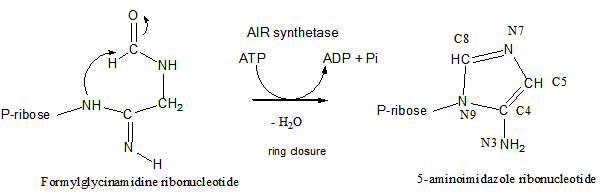
Step 5: An intramolecular coupling reaction accompanied by a loss of water forms the five-membered imidazole ring. The carbonyl is activated by phosphorylation and the phosphate is displaced by an amino group as shown on p. 5 (top)
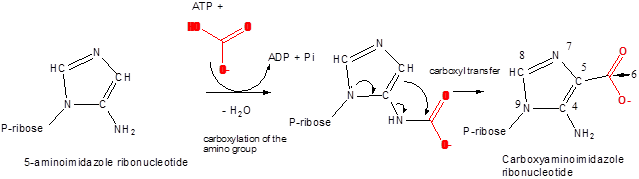
Step 6: Bicarbonate adds first to the exocyclic amino group and then is transferred to the neighboring carbon atom of the imidazole ring:Enzyme: AIR carboxylase
Step 7: The imidazole carboxylate is phosphorylated, and the phosphate is displaced by the amino group of aspartate:
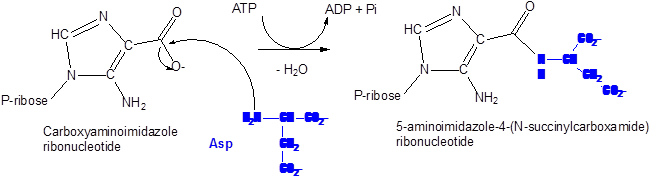
Enzyme: SAICAR synthetase