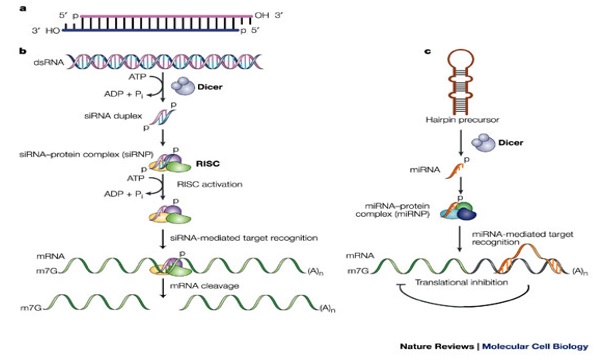
Fig 6-3.3.1: Gene silencing by RNAi: a. Double stranded RNA construct formed by introducing antisense RNA into the system; b. Mechanism of generation of siRNA from dsRNA by Dicer in presence of ATP; c. Generation of miRNA from hairpin precursor RNA (shRNA) by Dicer.(Source: http://www.nature.com/nrm/journal/v4/n6/fig_tab/nrm1129_F1.html, reprinted with permission.)
6-3.3.2 Retroviral mediated gene transfer:
Retrovirus is a virus of family “Retroviridae” that has RNA as its genetic material and replicate inside the host cell using reverse transcription machinery (to convert RNA to DNA). Retroviruses are commonly used as vectors to transfer genetic material into the host cell because of its high efficiency to transfer RNA to the host. Recombinant retrovirus RNA genome is then copied by reverse transcriptase (encoded by retrovirus) to yield a DNA copy, which then becomes integrated into the host genome at random sites. The offspring results from such transformation are chimeric, an organism consisting of tissues of diverse genetic constitution. To transmit transgene to next generation, any gene transfer technique including retroviral mediated should target germline cells. Generally, early 4-16 celled embryos are used to get maximum of retrovirus infection resulting in chimeric animal. Although homozygosity is attained just after several generations of selfing, these chimeric animals are inbred for 10-20 generations to obtain homozygous transgenic animals.