4-1.3.3.1.2. Separation based on conformation
Plasmids are supercoiled molecules formed by partial unwinding of double helix of the plasmid DNA during the plasmid replication process by enzymes called topoisomerases. The supercoiled conformation can be maintained when both polynucleotide strands are intact, hence called covalently closed-circular (ccc) DNA. If one of the polynucleotide strands is broken, the double helix reverts to its normal relaxed state taking an alternative conformation, called open-circular (oc). Super coiling is important in plasmid preparation due to the easy separation of supercoiled molecules from non-supercoiled ones.
The commonly used methods of separation based on conformation are as follows-
4-1.3.3.1.2(a). Alkaline denaturation method
• This method is based on maintaining a very narrow pH range for the denaturation of non-supercoiled DNA but not the supercoiled plasmid (Figure 4-1.3.3.1.2(a).).
• Addition of sodium hydroxideto cell extract or cleared lysate (pH12.0-12.5) results in disruption of the hydrogen bonds of non-supercoiled DNA molecules.
• As a result, the double helix unwinds and two polynucleotide chains separate.
• Further addition of acid causes the aggregation of these denatured bacterial DNA strands into a tangled mass which can be pelleted by centrifugation, leaving plasmid DNA in the supernatant.
Advantage
• Most of the RNA and protein under defined conditions (specifically cell lysis by SDS and neutralization with sodium acetate) can be removed by the centrifugation.
• No requirement of organic extraction.
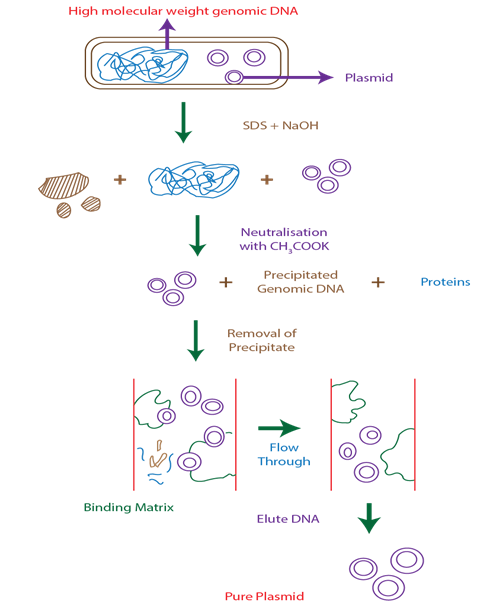
Figure 4-1.3.3.1.2(a): Separation of plasmid DNA by Alkaline denaturation method