Human Cromosome: The human genome is 3 x 10⁹ base pairs of DNA and the smallest human chromosome is several times larger than the entire yeast genome; and the extended length of DNA that makes up the human genome is about 1 m long. The human genome is distributed among 24 chromosomes (22 autosomes and the 2 sex chromosomes), each containing between 45 and 280 Mb of DNA (Figure 1). The sex chromosomes are denoted by X and Y and they contain genes which determine the sex of an individual i.e., XX for female and XY for male. The rest are known as autosomes. The haploid human genome contains about 23,000 protein-coding genes, which are far fewer than had been expected before sequencing. In fact, only about 1.5% of the genome codes for proteins, while the rest consists of non-coding genes, regulatory sequences, introns, and noncoding DNA. Chromosomes are stained with A-T (G bands) and G-C (R bands) base pair specific dyes (Figure 1). When they are stained, the mitotic chromosomes have a banded structure that unambiguously identifies each chromosome of a karyotype. Each band contains millions of DNA nucleotide pairs which do not correspond to any functional structure. G-banding is obtained with Giemsa stain yielding a series of lightly and darkly stained bands. The dark regions tend to be heterochromatic and AT rich. The light regions tend to be euchromatic and GC rich. R-banding is the reverse of G-banding where the dark regions are euchromatic and the bright regions are heterochromatic.
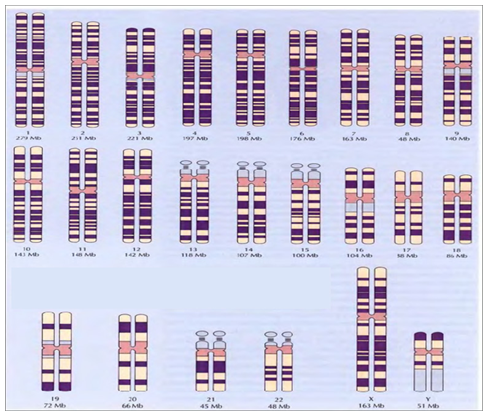
Figure 1: Human metaphase chromosome showing the banding pattern obtained after cytogenetic staining. This figure has been adapted from “The Cell, A Molecular Approach” by Geoffrey M. Cooper, 4th Ed. 2007.
Types of human chromosomes
There are four types of chromosomes based upon the position of the centromere in humans (Figure 2).
1) Metacentric: In this type of chromosome the centromere occurs in the centre and all the four chromatids are of equal length.
2) Submetacentric: In this type of chromosome the centromere is a little away from the centre and therefore chromatids of one side are slightly longer than the other side.
3) Acrocentric: In this type of chromosome the centromere is located closer to one end of chromatid therefore the chromatids on opposite side are very long. A small round structure, attached by a very thin thread is observed on the side of shorter chromatid. The small round structure that is a part of the chromatid is termed as satellite. The thin strands at the satellite region are termed as Nucleolar Organiser Region.
4) Telocentric: In this type of chromosome the centromere is placed at one end of the chromatid and hence only one arm. Such telocentric chromosomes are not seen in human cells.