Stages of meiosis
Meiosis can be separated into two phases which are meiosis I and meiosis II and they can be further subdivided into numerous phases which have particular identifiable features. They have been broadly described in the following sections.
Meiosis I
In meiosis I, chromosomes in a diploid cell segregate, producing four haploid cells generating genetic diversity. The stages of meiosis I are:
A. Prophase I
During this phase DNA is exchanged between homologous chromosomes or sister chromatids in a process called homologous recombination. The replicated chromosomes are called bivalents and have two chromosomes and four chromatids, with one chromosome coming from each parent. This phase can be further subdivided into Leptotene, Zygotene, Pachytene, Diplotene and Diakinesis. The different stages have been pictorially presented in the following section.
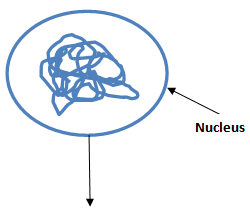
1. Leptotene It is a very short duration stage and progressive condensation of chromosomes takes place. In this stage the chromosomes are first observed as thin threads and are said to be in a diffused state. The sister chromatids are tightly packed and indistinguishable from one another. |
 |
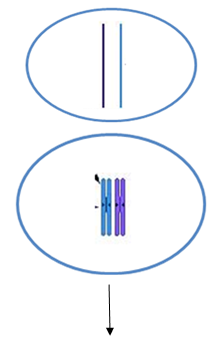
2. Zygotene Chromosome duplication occurs and the homologous chromosomes pair up with each other. Purple and blue represent homologous duplicated chromosomes. |
 |
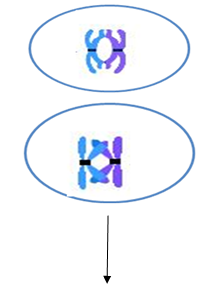
3. Pachytene Chromosomal crossover (crossing over) occurs by chiasma formation between homologous chromosomes. Nonsister chromatids of homologous chromosomes may exchange segments over regions of homology by a process called recombination. The region where crossing over occurs is known as chiasmata. |
 |
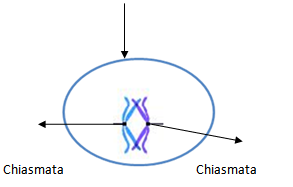
4. Diplotene Homologous chromosomes separate from one another a little but remain attached at the chiasmata. |
 |
5. Diakinesis Chromosomes condense further during the diakinesis stage. This is the first point in meiosis where the four parts of the tetrads are actually visible. Sites of crossing over entangle together, effectively overlapping, making chiasmata clearly visible. The rest of the stage closely resembles prometaphase of mitosis; the nucleoli disappear, the nuclear membrane disintegrates into vesicles, and the meiotic spindle begins to form. |
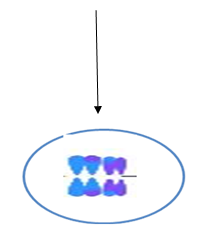 Figure 2: Stages of Meiosis I |