Introduction
The compressible flows are normally characterized as variable density flows. Pressure gradient, variable area, heat exchange and friction are few mechanisms that can change the density during a flow. But the conditions will vary for liquids and gases. For instance, the pressure gradient causes predominant change in the velocity keeping density as constant for liquids. In the other hand, the change in pressure can cause substantial velocity and density change for gases. When the density variation is less the 5%, the gases are still in the incompressible limit and the measurement techniques discussed earlier can be extended to the gases as well. However, if the density variation is substantial (more than 5%), then the measurement methods are different. The incompressible limit fails when the Mach number  of the flow is more than 0.3 and the flow remains subsonic till
  . I f the Mach number of the flow is progressively increased, then one may reach the supersonic
  and hypersonic
  limits. In other words, the variation in density is normally associated with high speed flows.
In the compressible flow measurements category, some of the flow parameters such as pressure, temperature are measured directly while others are calculated from the measured parameters using gas dynamic relations. When the measurements are performed for supersonic/hypersonic flows, a shock wave remains attached to the body geometry across which the static pressure, temperature and density variations are very high. Hence, the measured parameters only provide the information that prevail after the shock. Using shock wave relations, indirect calculation can be made to infer the desired flow parameters. Moreover, many advance measurement techniques involve flow field visualization through density variation to get back the information of pressure and velocity. Some of the basic compressible flow measurement techniques are discussed here.
Measurement of Temperature
In general, the static temperature along with the pressure determines the thermodynamic state of fluid at any instant. With compressible flow field, the temperature and velocity of the flow is normally very high. In order to get the static temperature, the measuring device must travel at the fluid velocity without disturbing the flow which is quite unrealistic. So, the indirect determination of static temperature measurement is done by using thermocouples by exposing directly into the flow or mounting them on the wall surface. At any case, the flow disturbance due to obstruction of temperature sensing device should be minimized.
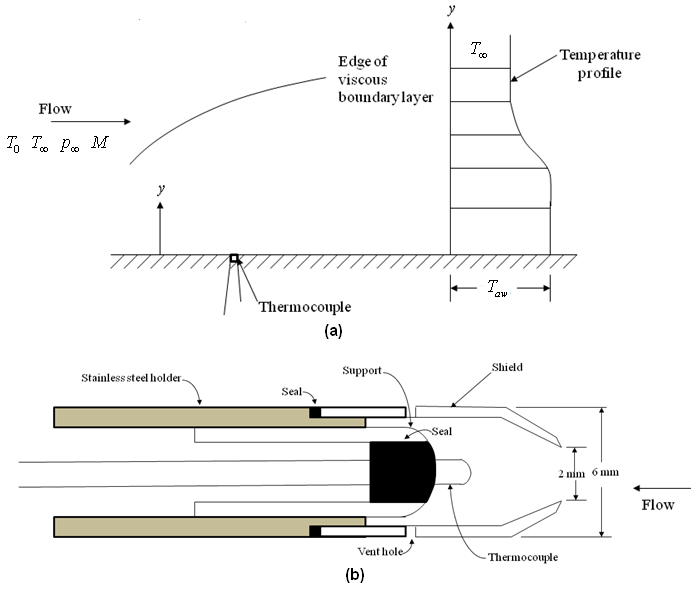
Fig. 7.5.1: Schematic diagram of temperature measurement for compressible flows: (a) thermocouple located at the wall surface; (b) temperature probe facing the flow.