Inviscid Hypersonic Flow Relations
In general, the hypersonic flows are characterized with viscous boundary layers interacting the thin shock layers and entropy layers. The analysis of such flow fields is very complex flows and there are no standard solutions. In order to get some quantitative estimates, the flow field at very high Mach numbers is generally analyzed with inviscid assumption so that the mathematical complications are simplified. In conventional supersonic flows, the shock waves are usually treated as mathematical and physical discontinuities. At hypersonic speeds, some approximate forms of shock and expansion relations are obtained in the limit of high Mach numbers.
Hypersonic shock relations
Consider the flow through a straight oblique shock as shown in Fig. 4.7.1(a). The notations have their usual meaning and upstream and downstream conditions are denoted by subscripts ‘1' and ‘2', respectively. Let us revisit the exact oblique shock relations and simplify them in the limit of high Mach numbers.
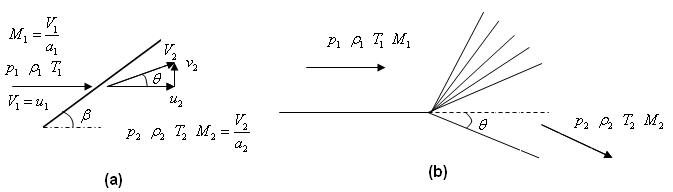
Fig. 4.7.1: Geometry of shock and expansion wave: (a) oblique shock; (b) centered expansion wave.
The exact oblique shock relations for pressure, temperature and density ratio across the wave are given by,
 |
(4.7.1) |
As,  , so that Eq. (4.7.1) becomes,
 |
(4.7.2) |
It may be noted that for air  flow in the hypersonic speed limit, the density ratio approaches to a fixed value of 6. The velocity components behind the shock wave, parallel and perpendicular to the upstream flow, may be computed from the following relations;
 |
(4.7.3) |
For large values of  , the Eq. (4.7.3) can be approximated by the following relations;
 |
(4.7.4) |