Stress Field
With respect to Newton 's laws of motion, force must be applied to induce acceleration on a body. Since, the fluid is treated as ‘continuum', one must understand the types of forces that act on the fluid particles. In general, each fluid particle experiences surface forces (i.e. pressure, friction) and body forces (i.e. gravitation). The surface forces are generated by their contacts with other fluid particles and solid medium, leading to stresses. The body forces are experienced throughout the particle and the gravitational body force per unit volume is quantified as  , where ρ is the density and
  is the gravitational acceleration.
The concept of stress describes the way in which the surface forces acting on the fluid and solid boundaries are transmitted into the medium. In a solid, the stresses are induced within the body. In the case of fluids, when a body moves through a fluid, stresses are developed within the fluid. Consider the contact force generated between fluid particles when the surface of a fluid particle in contact with other (Fig. 2.5.3-a). If a portion of the surface  is considered at some point ‘P ', the orientation of is given by the unit vector
  drawn normal to the particle outward. The force
  acting on can be resolved into two components; normal to the area and tangent to the area (Fig. 2.5.3-b). The stresses are then quantified with respect to this force per unit area. Thus, the normal stress
  and shear stress
  are then defined as below;
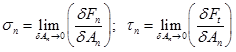 |
(2.5.15) |
Since fluid is treated as ‘continuum', it is possible to resolve these forces around the point ‘P ' to get different stresses around that point. In rectangular coordinates, the stressed can be considered to act on the planes drawn as outward normal in the respective x, y and z directions (Fig. 2.5.3-c). Then, Eq. (2.5.15) can written for x- direction as,
 |
(2.5.16) |