In general, there are two broad paths by which the fluid motion can be analyzed. The first case uses the estimates of gross effects of parameters involved in the basic laws over a finite region/control volume. They have been discussed in the previous sections. In the other one, the flow patterns are analyzed point-by-point in an infinitesimal region and the basic differential equations are developed by satisfying the basic conservation laws.
Concept of Material Derivative
The time and space derivative applied to any fluid property can be represented in mathematical form and called as substantial/ material/total time derivative. The Lagrangian frame follows the moving position of individual particles while the coordinate systems are fixed in space, in case of Eulerian frame of reference and hence, it is commonly used. Let us illustrate the concept of material derivative through velocity field. In Eulerian system, the Cartesian form of velocity vector field is defined as,
 |
(2.5.1) |
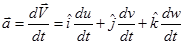
Using Newton 's second law motion, for an infinitesimal fluid system, the acceleration vector field  for the flow can be computed
 |
(2.5.2) |
Each scalar component of  is a function of four variables
  and also,
  . So, the scalar time derivative is obtained as,
 |
(2.5.3) |
The compact form of total derivative of are written as,
 |
(2.5.4) |
The compact dot product involving  and gradient operator
  is defined as,
 |
(2.5.5) |
The total acceleration is obtained as,
|
(2.5.6) |
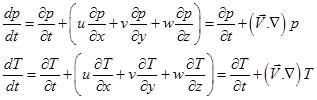
The term  is called the local acceleration and it vanishes when the flow is steady. The other one in the bracket is called the convective acceleration which arises when there is a spatial velocity gradient. The combination of these two is called as substantial/ material/total time derivative. This concept can be extended to any scalar/vector flow variable. Similar expression can be written for pressure and temperature as well.
 |
(2.5.7) |