40.3 Counterflow Drag Reduction Technique
Injection of a supersonic jet from the stagnation point of a blunt body changes the pressure and temperature distribution over the configuration of interest. The expected flow field around the blunt cone with counter flow injection is shown in Fig. 40.2. When the gas of total pressure, P0j, and total temperature, T0j, is injected from the stagnation point then the formation of jet and its properties at the exit of the orifice depend on the ratio, P0j/P02, where P02 is the freestream pitot pressure. If P0j is very high in comparison with P02, to achieve the chocked flow at the exit, then the jet separates at the edge of the orifice and moves forward. Separation of the jet at the edge forms a toroidal recirculation region near the stagnation point. Expansion of the jet from the orifice continues until it passes through a terminal shock. An interface gets formed after the terminal shock at the stagnation point where jet meets the freestream decelerated by the bow shock. This stagnation point is normally called as ‘free stagnation point’, since position of this stagnation point depends on P0j for the given freestream conditions. Heat, mass and momentum transfers are expected to take place between freestream and jet across the interface. This jet deflects from the free stagnation point and reattachment of the jet layer on the body takes place with a turning shock. Fluid in the recirculation region gets entrained in the jet layer forming the shear layer. Formation of such a low pressure and low temperature recirculation region gives rise to reduction of wave drag and heat transfer.
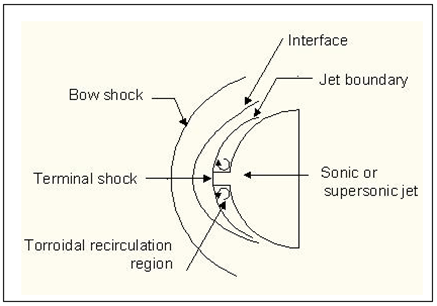
Fig. 40.2. Typical flowfield with counterflow injection based drag reduction technique