The variation of viscosity with temperature in liquid and gases can be explained as follows. The increase in temperature results in increase in spacing between the molecules and molecular mobility. In liquids, the viscosity is mostly due to cohesion forces, with increase in spacing between molecules, the cohesive force and viscosity reduces. Therefore, viscosity reduces with temperature in liquid. On the otherhand, in gases the major contribution from viscosity comes from the mobility of the molecule because they have negligible cohesive force due to large separation of molecules. Since the molecular mobility increases with temperature, the viscosity of gases increases with temperature. The
viscosity of liquid mostly increases with increase in pressure except for water in which viscosity decreases upto a few hundred atmosphearic presure, beyond that it increases. The rate of rise in viscosity with pressure enormously differ for different liquids. However, such variation are observed only at high pressure of the order of |
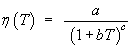 ,
, .
. . In gases, when the applied pressure is in the order of atmospheric pressure, no appreciable change in viscosity is observed with increase in pressure. However at high pressure the viscosity increases with pressure.