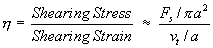
5.Stoke's Law : As we know, the frictional forces appear whenever there is a relative motion between two bodies. For example, when a car moves on the road, the frictional force appear between the tyre of the car and the road. The above frictional force is proportional to the velocity of the body but acts in opposite direction. Similarly, the falling bodies through a viscous fluid medium undergo frictional forces. For example, the raindrop falling through atmospheric air and falling of small solids such as stones, sand, ball bearing through a long column of water or any other viscous fluid experience a dragging viscous force. Let us take an example of small solid spherical ball with smooth surface falling over a long column of a liquid. As the ball is droped, it's velocity increases due to gravitational force, and the retarding frictional force due to viscosity also increases. A stage is reached at which the frictional force is just equal in magnitude but opposite in direction to the gravitational force. Under this condition, the falling body moves with constant velocity called terminal velocity The British scientist, Sir George G. Stokes (1819-1903) showed that the retarding force Fv due to viscosity acting on a spherical body of a radius 'a' falling through a medium of viscosity |
 .
.  is
is ........................................(1)