Wilson Current Source
Another current source transistor configuration that provides a very large parallel resistance is the Wilson current source which uses three transistors and provides this capability an the output is almost independent of the internal transistor characteristics. The Wilson current source as shown in fig. 3, uses the negative feedback provided by Q3 to raise the output impedance
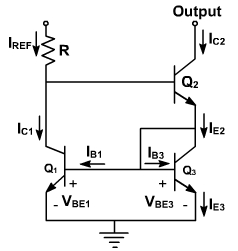
Fig. 3
The difference between the reference current and IC1 is the base current of Q2.
IE2 =(β + 1) IB2 = IC3 (E-9)
Since the base of Q1 is connected to the base of Q3, the currents in Q1 are approximately independent of the voltage of the collector of Q2. As such, the collector current of Q2 remains almost constant providing high output impedance.
Let us now see that IC2 is approximately equal to IREF. Applying Kirchhoff's current law at the emitter of Q2 yields
IE2 = IC3 + IB3 + IB1 (E-10)
Using the relationship between collector and base currents
(E-11)
Since all three transistors are matched, VBE1= VBE2 = VBE3 and β1 = β2 = β3
With identical transistors, current in the feedback path splits equally between the bases of Q1 and Q3 leading so that IB1 = IB3 and therefore IC1 = IC3. Thus, the emitter current of Q2 becomes
(E-12)
The collector current of Q2 is
(E-13)
Solving for IC3 yields
(E-14)
Summing currents at the base of Q2,
(E-15)
(E-16)
Since IC1 = IC3, we substitute IC3 to obtain
(E-17)
and solving for IC2
(E-18)
Equation (E-10) shows that β has little effect upon IC2 since, for reasonable values of β.
(E-19)
Therefore, IC2 = IREF