Stability of quiescent operating point:
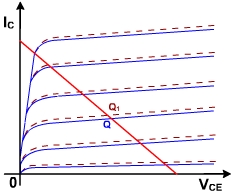
Let us assume that the transistor is replaced by an other transistor of same type. The bdc of the two transistors of same type may not be same. Therefore, if bdc increases then for same IB, output characteristic shifts upward. If bdc decreases, the output characteristic shifts downward. Since IB is maintained constant, therefore the operating point shifts from Q to Q1 as shown in fig. 5. The new operating point may be completely unsatisfactory.
Therefore, to maintain operating point stable, IB should be allowed to change so as to maintain VCE & IC constant as bdc changes.
Fig. 5
A second cause for bias instability is a variation in temperature. The reverse saturation current changes with temperature. Specifically, ICO doubles for every 10oC rise in temperature. The collector current IC causes the collector junction temperature to rise, which in turn increases ICO. As a result of this growth ICO, IC will increase ( bdc IB + (1+ b dc ) ICO ) and so on. It may be possible that this process goes on and the ratings of the transistors are exceeded. This increase in IC changes the characteristic and hence the operating point.
Stability Factor:
The operating point can be made stable by keeping IC and VCE constant. There are two techniques to make Q point stable.
- stabilization techniques
- compensation techniques
In first, resistor biasing circuits are used which allow IB to vary so as to keep IC relatively constant with variations in bdc , ICO and VBE.
In second, temperature sensitive devices such as diodes, transistors are used which provide compensating voltages and currents to maintain the operating point constant.
To compare different biasing circuits, stability factor S is defined as the rate of change of collector current with respect to the ICO, keeping bdc and VCE constant
S = ¶ IC / ¶ ICO
If S is large, then circuit is thermally instable. S cannot be less than unity. The other stability factors are, ¶ IC / ¶ bdc and ¶ IC / ¶ VBE. The bias circuit, which provide stability with ICO, also show stability even if b and VBEchanges.
IC = b dcIB + (I + b dc ) ICO
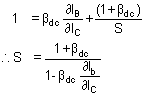
Differentiating with respect to IC,
In fixed bias circuit, IB & IC are independent. Therefore
and S = 1 + bdc. If b dc=100, S = 101, which means ICincreases 101 times as fast as ICO. Such a large change definitely operate the transistor in saturation.