Output Offset Voltage:
In an OPAMP even if the input voltage is zero an output voltage can exist. There are three cause of this unwanted offset voltage.
- Input offset voltage.
- Input bias voltage.
- Input offset current.
Fig. 4, shows a feedback amplifier with an output offset voltage source in series with the open loop output AVd. The actual output offset voltage with negative feedback is smaller. The reasoning is similar to that given for distortion. Some of the output offset voltage is fed back to the inverting input. After amplification an out of phase voltage arrives at the output canceling most of the original output offset voltage.
When loop gain AB is much greater than 1, the closed loop output offset voltage is much smaller than the open loop output offset voltage.
Fig. 4


Voltage Follower:
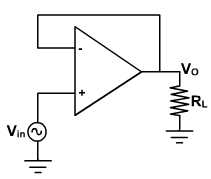
The lowest gain that can be obtained from a non-inverting amplifier with feedback is 1. When the non-inverting amplifier gives unity gain, it is called voltage follower because the output voltage is equal to the input voltage and in phase with the input voltage. In other words the output voltage follows the input voltage.
To obtain voltage follower, R1 is open circuited and Rf is shorted in a negative feedback amplifier of fig. 4. The resultant circuit is shown in fig. 5.
vout = Avd= A (v1 – v2)
v1 = vin
v2 =vout
v1 = v2 if A >> 1
vout = vin.
The gain of the feedback circuit (B) is 1. Therefore
Af = 1 / B = 1
Fig. 5